Showing posts with label the good folk. Show all posts

Monday, June 24, 2019

Tlachtga/Hill of Ward


On the first day the group for the Wolves, Witches and Warbands Irish pilgrimage met up, we made a visit to Tlachtga/Hill of Ward, a ring fort and sacred site in Co. Meath. The weather was very cold, wet and grey, very reminiscent of a late fall day, instead of being on the cusp of Bealtaine, or how I pictured it would be at least in Ireland. Which I suppose was suitable, as there are some at least who think that Tlachtga is the birthplace of Samhain bonfires.


Before doing the group ritual, we all had a chance to explore the site a bit, after getting a little introduction by the lovely Gemma McGowan. The story of Tlachtga had a real impact on me, to the point of tears, but it was to the far corner of the field that the site is on that I first felt called to.


While others are priests of deities or the go-betweens on behalf of the Othercrowd, I was the dipshit on the fringe of sites chatting with trees and plants, and listening to what the birds had to say. This ended up being a personal theme for me at each site I was able to visit, giving me the opportunity to connect with various different spirits and beings of those places. At this particular spot it was the humble stinging nettle that had the most to teach me. 


Only until pretty recently Tlachtga has been often overlooked as far as importance goes, but it is growing in popularity. There has been Samhain festivities held there, and a couple years back there was an archaeological dig. 

Some links of interest:


A really beautiful spot. <3


Wednesday, April 26, 2017

The Gaelic Roundtable for April: Veneration


This is my second post participating in The Gaelic Roundtable blogging project, April's subject is Worship. The Roundtable asked:
"Which Gaelic Gods do you Worship? Do you worship your Ancestors or otherwise participate in Ancestor Veneration and related practices? What about the Gaelic Heroes? The Fae? How long have you Worshiped them? Who came first? Last? Second? How did you establish your relationships with them, and how important is that relationship to you? How integral is that relationship to your spirituality? Your religion? Your every day life?"
As far as my own personal practice goes, I tend to shy away from the term "worship" ; while perhaps just a semantics game, I associate worship with coming from a place of grovelling or fear. This might be just a holdover from my Christian upbringing. Instead I would like to think that my devotion comes from a place of hospitality and respect, so I prefer to use "honour" or "venerate" in my approach to the Gods, Spirits and Ancestors.

My relationships with The Three play a central role both in my faith and in my daily life. At our hearth shrine I do a small devotional every morning with an offering, prayer and candle lighting {kindling} and do another small one in the evening with a prayer and extinguishing the candle flame {smooring}. There are special dates in which I honour specific individuals and during certain activities I will make offerings and ask for blessings as well.  

The Gods


In general I honour all the Gods of the Gaels, however, there is a handful of deities that I am especially devoted to, whom I call "household deities". My relationships with them are pretty much all different from each other, some being stronger in certain seasons or when I am doing certain activities. Some I have actively sought out, while others it seems that they have "tapped me on the shoulder".

Brigid

 From the best of my memory, Brigid was the very first Goddess that I did any research on and try to summon back when I was first exploring Paganism. For quite a few years my approaching her was limited to Imbolc and some petitioning, and it wasn't until after I started delving into Celtic Recon that it started to go beyond that. That was some time ago and her along with another Goddess below was the first that I became devoted to. As time went on I eventually became one of her flamekeepers, which I have been doing for two or three years. During every cycle I make offerings to her and of course at Imbolc and Latha na Caillich. For my own life I feel that she oversees keeping of the home, healing, protection, relationships and women's fertility/sexuality.

Macha

Prior to subscribing to hard polytheism I honoured a generic "Mare Goddess", whose faces included Macha, Epona and Rhiannon. So, my relationship with Macha continued on once becoming a Gaelic Polytheist and became deeper, richer. I have always had a great love for horses, so a part of my devotion to her is to do my part to end horse abuse and slaughter. Corvids are also my buddies. During Lughnasadh and Michaelmas I make special offerings to her and for myself I think that she aids in divination, sovereignty, abundance, justice and protection.

Flidais

Besides honouring a "Mare Goddess" as an eclectic Pagan, I also paid homage to a generic "Antlered Woodland God" {think Herne or Cernunnos,}, so when I came across info about Flidais for the first time my interest was piqued. After doing a wee bit more research I made some offerings to her and have built the connection over time. Besides deer and cattle, I also associate robins and foxes with her. During Bealtaine and prior to doing wildcrafting or going out in the bush I will make offerings to Flidais. For me she helps as a catalyst with Nature Spirits, and also helps with environmentalism, bushcraft/wildcrafting. lust/sexuality, and beauty.

Airmed

Having a keen interest in plants and herbal healing, it was only a matter of time before I tried to establish a relationship with Airmed. She plays an essential role in all of my gardening, working with plants, and all healing {both emotionally and physically}. Being someone who has faced abuse I felt a strong connection with her own story. I associate bees with her and therefore is an especially sacred pollinator. Offerings are made to her on Midsummer and during any herb harvest and working with plants. 
An Cailleach

This is the one Goddess out of the group that I definitely feel was "lurking in the shadows". By the time she popped up I had already heard about her, but was quite intimidated to try to connect with her. After some really intense dreams and other happenings, I was certain who was there but was quite bewildered as to why she was there. For about a year I did more research and asked other Gaelic Polytheists about their experiences with her. It wasn't until after I felt that I learned as much as I could that way that I apprehensively tried to make a formal connection {more about that can be read here.} To be honest she still does kind of intimidate me, but at times she can have a warmth about her. My connection to her is twofold, being both seasonal and due to my occupation. In the winter months she is ever present, and I make special offerings to her during Samhain, Yule, and Latha na Caillich. I also turn to her for insights on how to deal with the hardships of aging, as I work in long term care with the elderly. 

Ancestors


Ancestor reverence is something I practiced prior to becoming a Gaelic Polytheist, but became even more important to me when my maternal grandparents passed away. When still living in North Bay I would regularly go to the small family cemetery to visit. Now that I am a few hundred miles away, I have been scoping out the various Irish memorials here in town to leave offerings. I do keep an Ancestral shrine in my home where I make regular offerings, and hold special rituals dedicated to my Ancestors during Samhain, Remembrance Day, Christmas, and on  certain birthdays and anniversaries.

Spirits/The Good Folk


Besides being a polytheist, I am an animist as well, so I essentially believe that everything has a spirit. To me trees have spirits, the stones do, animals do, and are just as important as humans. As well, I believe that sometimes beings may be attached to a certain place, sometimes a body of water or piece of land or a building. These spirits {nature spirits/genii loci/The Good Folk} I feel are due the same amount of respect as the Gods or Ancestors and give them the same hospitality, although my approach to them is sometimes different. 

On top of keeping indoor and outdoor shrines, there were certain places where I would leave regular offerings and act as a steward of sorts. These were generally places that I would wildcraft from and do rituals at. As of right now I am still getting know my new area and the spirits that are here. So, a work in progress. ;) 

*********

If you are a Gaelic Polytheist, why not join us at The Gaelic Roundtable? I am looking forward to the posts of the other contributors!

Sláinte!

Laurel

Thursday, April 18, 2013

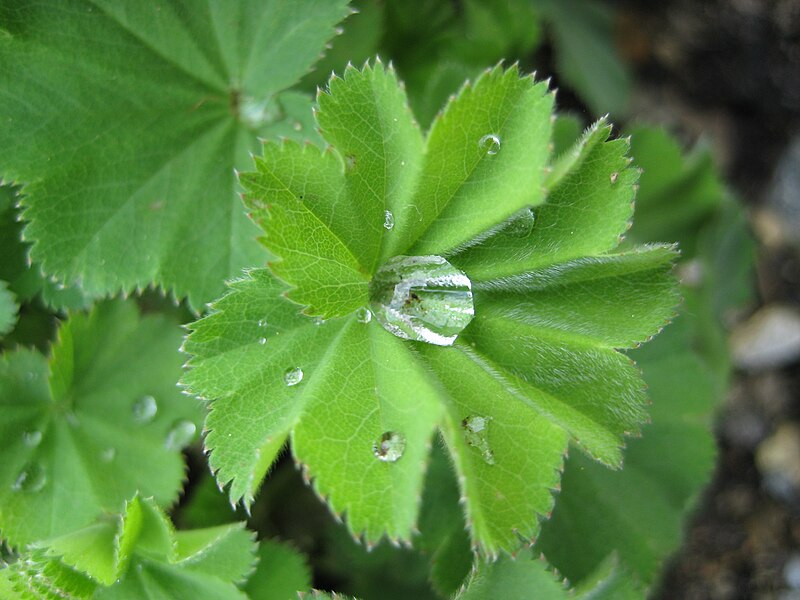
Lady's Mantle {Alchemilla vulgaris}


Photo from Jina Lee
Our Lady's Mantle ! When I musing stray
In leafy June along the mossy sward,
No flower that blooms more fixes my regard
Than thy green leaf, though simple its array;
For thou to me art as some minstrel's lay,
Depicting manners of the olden time,
When on Inch Cailliach's isle the convent chime
Summoned to Vespers at the close of day.
Tis pleasant 'mid the never-ending strife
Of this too busy, mammon-loving age,
When Nature's gentler charms so few engage,
To muse at leisure on the quiet life
Of earlier days, when every humble flower
Was known to all, and cherished as a dower.


~To Our Lady's Mantle from Sonnets and Miscellaneous Poems By James Inglis, 1853

Other Names: Common Lady's Mantle, Lion's Foot, Copan an Druichd, Bear's Foot, Falluing Mhuire,  Nine Hooks, Frauenmantle, Pied-de-lion.


Description: Lady's mantle is a lovely perennial that is a member of the rosaceae family. It can be found growing in the wild in England, Scotland, Canada, Greenland, and in much of Northern Europe and Asia.

It could be described as a demure plant, but as Ms Grieve said 'the rich form of its foliage and the beautiful shape of its clustering blossoms make it worthy of notice'.
From Wikimedia Commons
It is a low growing plant that doesn't grow to much more than 14 inches in height, and it has pretty yellowish-green flowers free of petals. It's prize feature is the wonderfully 'scalloped' leaves, which is said to resemble the Virgin Mary's cloak, from which it gets its name.

Warnings: As with all herbs, one should make sure to be thoroughly informed before ingesting them, and is best to do so under the guidance of a qualified healer.

Lady's mantle has reportedly been linked with liver damage in some cases, and many herbalists warn to women notify their health practitioner if they are pregnant or breastfeeding before ingesting the herb.

Cultivating: The natural habitat of lady's mantle is quite vast from meadows, sunny woodlands, by streams and other moist areas, as well as mountainous regions. It is a plant that does well in cooler climates and is generally thought to be suitable for hardiness zones 3 to 7.

Growing it from seed can be sometimes difficult, so it might be easier just to by seedlings or plants from a nursery. If you are going to grow it from seed, just keep in mind that it is quite slow to germinate.

Plant in the spring once there is no more chance of frost, in a spot that is anywhere from full sun to partial shade. It will do well in just about any type of soil, just make sure it is well-drained.

Mulching is a good idea, but lady's mantle is apparently quite drought-resistant. Also keep in mind that if it is doing well, it will drop plenty of seeds and spread, so you can always dead head the flowers if you want to have some control over this.

Some other plants that looks beautiful growing with lady's mantle are poppy, iris, fleabane, phlox, lily, and catmint.

Medicinal/Remedial Properties and Lore: Astringent, anti-inflammatory, diuretic, emmenagogue, febrifuge, sedative, styptic, tonic, vulnerary.

Lady's mantle has a long history of use for healing an assortment of ailments: from wounds and bruises, to vomiting and other stomach problems, as well as women's complaints.

One of the most interesting recommendations I found was from good old Culpeper who said, 'such women that have large breasts, causing them to grow less and hard, being both drank and outwordly applied'.

He also suggested its use for women who wished to conceive by drinking a tea, and claimed that it was great for wounds 'green, not suffering any corruption to remain behind, and cures all old sores, though fistulois and hollow'.

Onto Brother Aloysius, who recommended it for heavy bleeding, ulcerated lungs, dysentery, consumption, and ulcers. Like Culpeper, he also mentions in its helpfulness in the boob department, but this time for 'swollen' breasts.

Susun Weed proposes a tincture of fresh root as 'an excellent blood coagulant' and advocates its use for all types of 'female problems' {Wise Woman Herbal for the Childbearing Year}.

I can attest the helpfulness of lady's mantle when it comes to PMS and periods; I like making a tea with it paired with lemon balm {also great for these issues} because it does taste a little bitter and lemon balm has a more pleasant taste.


Photo from Aconcagua
Magical Properties and Lore:

The Latin name Alchemilla roughly translates 'small magical one', and was a plant of Alchemists who collected the dew found on the leaves for their workings.

In the book Folk-Lore of Women by Thomas Firminger Thiselton-Dyer (1906) it is said that lady's mantle 'was once in great repute with ladies; for, according to Hoffman, it had the power of restoring feminine beauty, however faded, to its early freshness'. Some women would collect dew found on the leaves on Bealtaine morning for this purpose.

Associated with the Virgin Mary, as the leaves are said to resemble her mantle, I also remember hearing a story when I was younger that the leaves were used as cloaks by the Good Folk.
 
Because of its use in women's health and healing, I have come to associate lady's mantle with the Goddesses Brigid {there is speculation by some folks that it is a herb historically tied to her} and Airmid.
 
According to some lady's mantle is connected to the planet and Goddess Venus, as well as other fertility, and Earth Goddesses. In some Swedish {and other Northern European traditions} it is placed under a woman's pillow if she wishes to dream of her future children; if worn in her hair during sex she would certainly become with child.

It was thought to ward off storms in Eastern Europe by burning it in a fire and letting the smoke go to the sky, or by hanging in windows and doors a farm would be kept safe from Nature's wrath.

In Polish-American Folklore by Deborah Anders Silverman she says that small wreaths of various types of herbs including lady's mantle are hung in homes to ward off evil spirits.
 
This is a herb that I like to use in tealeaf readings when the topic is one of love involving women {romantic, family, or platonic} and fertility of all types. I also think it is a splendid herb for love workings and for decorating on Bealtaine and Midsummer.

Other Uses:
The young leaves of lady's mantle are edible and can be served up raw or cooked, and the roots are also edible cooked.

It can also be used in beauty treatments! Below are some links to a few nifty recipes for you to try:

Hand lotion, facial steam, and bath vinegar

Hand mask

Sláinte!

Laurel

Sunday, December 9, 2012

European Mistletoe {Viscum Album}

{originally posted on the nefaeria blog in 2008, with a wee bit of updating}

photo by Rupert Ganzer
Along with conifers, poinsettias and holly, mistletoe is one of the plants most associated with the Yuletide season, so it is a perfect time to post about it I think.

There are other types of mistletoe, but for this post, I am focusing on the European or Common variety.

Other Names: Herbe de la Croix, All-Heal, Birdlime, Devil's Fuge, Mistletan.
 
Description: The European mistletoe is native to Britain, as well as to much of Europe. It is a hemiparastic evergreen that lives in mostly deciduous trees, and is compatible with at least 200 different host species.
 
It forms 'bushes' on the branches of trees, that are anywhere from 1.5 to 6 feet in diameter. The leaves are shaped like a tongue and they have white, round berries whose sticky juices have been noted to resemble semen.
 
Warnings: As with all herbs, one should make sure to be thoroughly informed before ingesting them, and is best to do so under the guidance of a qualified healer.
 
"Raw, unprocessed mistletoe is poisonous. Eating raw, unprocessed European mistletoe or American mistletoe can cause vomiting, seizures, a slowing of the heart rate, and even death." 
As well, they point out that in countries such as Germany have mistletoe that is available for therapeutic injection. There are potential side effects such as
"itching or redness in the area of the injection. Less commonly, side effects may include more extensive skin reactions, low-grade fevers, or flu-like symptoms. There have been very rare reports of more serious allergic reactions, such as difficulty breathing.'"
Also, avoid while pregnant, as it is known to cause contractions of the uterus.
 
Cultivating: Germination for the mistletoe usually begins once a bird's business is dropped on a its new host; the seeds sprout from the pile of bird poop, and then takes root in the bark of the tree.
 
The mistletoe mainly uses its host as a source of water and mineral nutrients, while its leaves do some photosynthesis. It usually bears fruit around the Winter Solstice.
 
According to Mrs. M Grieve, one could quite easily cultivate their own mistletoe simply by
"rubbing the berries on the smooth bark of the underside of the branches of trees till they adhere, or inserting them in clefts made for the purpose".
It is hardy to about a zone 5, and grows best in dappled shade. Brother Aloysius suggests that it be gathered in Autumn or Winter and that it should be dried and stored in sealed containers.
 
Medicinal/Remedial Properties and Lore: Antispasmodic, cardiac, cytostatic, diuretic, emmengogue, haemostat, hypotensive, narcotic, nervine, stimulant, tonic, vasodilator.
 
Culpeper said that
"misselto doth molify hard knots, tumours, and imposthumes...is a cephalic and nervine medicine, useful for convulsive fits, palsy, and vertigo."
Brother Aloysius recommended it for a variety of ailments including watery gall, jaundice, internal sores, convulsions and whopping cough.
 
Today mistletoe is mainly used for headaches, to lower blood pressure, to relieve anxiety and sleeplessness, and there are studies being done in it's effectiveness in combating cancer.
 
a holiday postcard, circa 1900
Magical/Spiritual Properties and Lore: It is said that Cesar saw Druids five days after the new moon following the Winter Solstice, climbing into oak trees and cutting mistletoe with golden sickles for ritual use. There are disagreements as to whether it was actually mistletoe or holly that they were cutting down.
 
According to Paul Beyerl's Master Book of Herbalism mistletoe is good for fertility, protection and visionary workings. For a Yule ritual in his book, people should toss a mistletoe berry into the hearth-fire to represent those personal things that one desires, as the sun comes back.
 
In some traditions, mistletoe is associated with solar deities because it bears fruit as the sun it at it's lowest point , and also lunar deities because of it's round, white fruit.
 
Once gathered, many sources say that it should not touch the ground, and it does indeed have many potential uses.
 
For protection, in Culpeper's Complete Herbal, he says that is can be hung around the neck to remedy witchcraft. Also, sprigs can be hung on doorways to protect houses from lightening and evil spirits; it can be placed by a cradle to avoid faeries {careful that little hands can't reach it!}; hung in a barn to protect a herd of cattle and buried in a field to protect a crop.
 
For this time of year, string up some mistletoe to get some kisses ;)
 
Where this custom actually originated from I am not sure, but there are a few that I have seen:
 
One involves the Norse God Baldr, who is killed by an arrow made of mistletoe, that is shot by Loki. After Baldr dies, Frigg cries and her tears become the white berries. In one version of the story, Baldr comes back to life, and Frigg is so happy that she blesses the mistletoe and says she will bestow a kiss to anyone who stands underneath it.
 
Under the Mistletoe, 1873
Another folktale says that if warring foes came under a tree with mistletoe on it, they would lay down their arms and kiss each other as a sign of peace.
 
I use mistletoe for various types of workings, including ones for protection, health/healing, divination, exorcism, fertility, romance, sexuality, and activities in the wild {hunting, camping, wildcrafting}.
 
Other Uses: It has long been thought that mistletoe is just a pest that not only kills off trees, but degrades entire habitats. But, according to a study done on the relationship between junipers and mistletoe, the mistletoe can actually play a role in protecting biodiversity.
 
Sláinte!
 
Laurel

Friday, June 8, 2012

Foxgloves


The foxglove bells, with lolling tongue,
Will not reveal what peals were rung
In Faery, in Faery,
A thousand ages gone.
All the golden clappers hang
As if but now the changes rang;
Only from the mottled throat
Never any echoes float.
Quite forgotten, in the wood,
Pale, crowded steeples rise;
All the time that they have stood
None has heard their melodies.
Deep, deep in wizardry
All the foxglove belfries stand.
Should they startle over the land,
None would know what bells they be.
Never any wind can ring them,
Nor the great black bees that swing them--
Every crimson bell, down-slanted,
Is so utterly enchanted.

Friday, April 6, 2012

Some Thoughts on Offerings


photo by Dominic Alves
Since my post on daily rituals I have had a few people email me and leave comments asking about what type of offerings I make, so I thought that I would do a small post on the subject.

In both my faith and craft offerings play a central role, and for me it is just as important to make sure it is a proper offering as it is to give it. This often means doing some research as well as experimenting.

Generally when we give gifts to loved ones, we put some thought into those gifts and making offerings is not much different. For example, I would never make an offering of alcohol to local nature spirits, as it may be seen as offensive, so instead I might give flowers or maple syrup. When making offerings for multiple recipients, you can either make individual offerings, or one that would be appreciated by all that the offering is given to; in the case of our daily offerings to our Deities, Ancestors and the Genii Loci, we often give honeyed water.

Every time I go wildcrafting I also make offerings, sometimes to each individual plant and sometimes to the small area that I am wildcrafting in. On occasions like this I think that it is especially important to make sure that whatever I am offering will not upset the local environment and is always biodegradable.

Making offerings to Ancestors might be the easiest to figure out if you knew them while they were alive. It could be their favourite food or drink, making a donation to their favourite charity, or even maintaining their gravesite.

Some of the people who contacted me are also Celtic Reconstructionists and were wondering about offerings to the Gods. Our home is dedicated to specific Deities within the Irish pantheon, so the offerings we do make to Them are tailored to each Deitiy. We also leave out offerings for the whole pantheon too, which is often good quality whiskey, mead and favoured foods. {There are a few wonderful online resources about making offerings as a Celtic Reconstructionist which I will list at the end of this post.}

Besides making sure that offerings are appropriate and thoughtful, the last important thing I like to keep in mind is quality. If the offerings are going to be something I make, then I will put my best effort into it. When it comes to ingredients and such, I will try and use local, organic, or items we have grown ourselves.

Well, I do hope that has answered some questions and if you folks have anymore, please feel free to contact me or leave a comment. Also, please do check out the links below:


Calendar Feasts and Customs by Francine Nicholson {some good ideas for offerings on the feast days for Celtic Reconstructionists}


How to Create a Genius Loci Profile by Sarah Lawless {a great way to really understand your local nature spirits and deciding what types of offerings to make}

Sláinte!

Laurel

Tuesday, March 13, 2012

Common Bluebell {Hyacinthoides non-scripta}


A fine and subtle spirit dwells
In every little flower,
Each one its own sweet feeling breathes
With more or less of power.
There is a silent eloquence
In every wild bluebell
That fills my softened heart with bliss
That words could never tell.
Yet I recall not long ago
A bright and sunny day,
'Twas when I led a toilsome life
So many leagues away;
That day along a sunny road
All carelessly I strayed,
Between two banks where smiling flowers
Their varied hues displayed.
Before me rose a lofty hill,
Behind me lay the sea,
My heart was not so heavy then
As it was wont to be.
Less harassed than at other times
I saw the scene was fair,
And spoke and laughed to those around,
As if I knew no care.
But when I looked upon the bank
My wandering glances fell
Upon a little trembling flower,
A single sweet bluebell.
Whence came that rising in my throat,
That dimness in my eye?
Why did those burning drops distil --
Those bitter feelings rise?
O, that lone flower recalled to me
My happy childhood's hours
When bluebells seemed like fairy gifts
A prize among the flowers,
Those sunny days of merriment
When heart and soul were free,
And when I dwelt with kindred hearts
That loved and cared for me.
I had not then mid heartless crowds
To spend a thankless life
In seeking after others' weal
With anxious toil and strife.
'Sad wanderer, weep those blissful times
That never may return!'
The lovely floweret seemed to say,
And thus it made me mourn.
~The Bluebell by Anne Bronte (1820-1849)

Other Names: English Bluebell, Auld Man's Bells, Ring-o'-Bells, Culverkeys, Wood Bells, Jacinth.

Description: The Common Bluebell is a perennial that is native to Britain. It can now also be found growing is some parts of North America, as well as other parts of Europe such as Portugal, France, and Ireland.

It is a bulbed woodland plant that is member of the Hyacinthaceae family. The plant has leaves that are a long lanceolate shape, which are located at the bottom half of the plant. The stem rises to a curve with spikes of their signature blue, pensile bell-shaped flowers on the top; the flowers themselves give of a wisp of a sweet fragrance.

It is thought that the Common Bluebell is under threat due to hybridization, and it is a protected species in the United Kingdom under the Wildlife and Countryside Act 1981. You can view a video here on how to identify different types of Bluebells.

Warnings: As with all herbs, one should make sure to be thoroughly informed before ingesting them, and is best to do so under the guidance of a qualified healer.

From what I understand, all parts of the Common Bluebell are considered poisonous, especially the bulb.

In a report released by the Canadian government, there are cases of both people and livestock being poisoned after ingesting the plant.

Reported symptoms of poisoning for humans included: abdominal pains, diarrhea, heart rate slowed, flushed skin. For cattle symptoms included: slowed heart rate, shallow breathing, lethargy, and depressed temperature; for horses: abdominal pains, diarrhea, moist and cold skin, absent urination, depressed temperature, and vomiting.

So I think it's safe to say not to ingest any parts of the plant, and to make sure that pets and livestock don't either.


Cultivating: The Common Bluebell's natural habitat is deciduous {often ancient} woodlands, hedgerows, and sometimes in shady meadows. It typically does well between hardiness zones 5 to 7. Depending on your region, it will flower anywhere from April to June.

It is an excellent plant to have in a woodland garden, or in a spot that is part sun to dappled shade. It prefers a slightly acidic soil, and it is probably best to use a fertile loam. However, I have heard that it can also grow in a heavy clay, and it can grow in 'dry' soil, providing that it gets enough shade and moisture.

The best way to start Common Bluebells from seed is to grow them in a pot for the first year, after a period of about 5 weeks of a cold-moist stratification. It can then be planted in its permanent home in the second year, once the leaves are dormant {late summer or early fall}.
Before planting it is a good idea to prepare the soil with an organic fertilizer {like compost}, and to mulch afterwards.

Some great plants to grow with it are Ferns, Daffodils, Tulips, Sweet Woodruff, and Hostas.

Medicinal/Remedial Properties and Lore: Diuretic, styptic.

The Common Bluebell is rarely used for medicinal purposed today, although there is research on its potential use for treatment in cancer and HIV.

It was historically thought by some to cure snake bites, as well as calm the effects of a bee sting if the juices from the stem were rubbed on the wound.

Sir John Hill recommended it for as a styptic for leucorrhoea, by drying the bulb and making into a powder, but he warned not to use anymore than 3 grains in a dosage.


Magical/Spiritual Properties and Lore: This is one plant that is strongly associated with the Fair Folk, as well as death.

In English folklore, Faeries were thought to congregate in a
'Bluebell wood'. If one were to trample into such a wood they could be cursed by the Faeries. They would leave them maimed or sick{ultimately leading to their death}, or the carry them away to never be seen again.

To hear the ringing of the Bluebell would be a harbinger of death or a signal that a troop of malevolent Faeries were near by.

For those who want to attract the sympathies of the Fair Folk, you can grow Common Bluebells in your garden. To attract them at Bealtaine, make posies of the flowers (not sure about what the law in the UK would say about picking them in the wild, but of course, this should be done respectfully!) to adorn your altar or ritual space.

Common Bluebells are a
funeral plant, and some appropriate uses are planting it on graves to bring peace and blessings, or to decorate as a decoration for a funeral, as well as a ancestor altar at Samhain.

They can also be an excellent charm to sew into a dream pillow to ward off not only nightmares, but also protect someone from a potential run in with a Succubus.

Other Uses: At one time the juice from the bulb was used as a replacement for starch in the days when stiff ruffs were worn was much in request {Mrs Maude Grieve}; English herbalist John Gerard told of the juice's usefulness to set feathers onto arrows, and it was also popular at one time to create a gum to bind books.
Sláinte!

Laurel