Showing posts with label binding. Show all posts

Sunday, October 21, 2012

Cross Quarter Waters

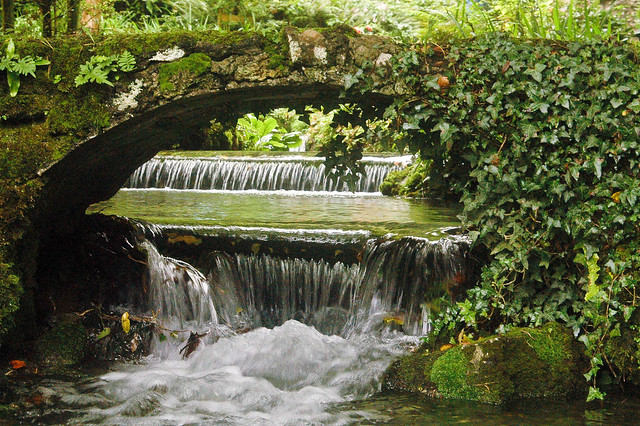
Tobernault Holy Well grotto in Sligo Co, Ireland. Photo by BA_Banks
During the cross quarters {to many neo pagans these are called the high sabbats} there are traditions of collecting water, whether it be from dew on a leaf, a holy well, or by leaving a bowl out to collect rain. Below you will see some of these traditions found in Ireland, Scotland & the Isle of Man, and I will share some of the ways that I collect water and what I use it for. If I am able to collect enough water, I will keep it in clean corked bottles {I usually re-use old whiskey bottles}.

Imbolc
 
There are a couple traditions that I have come across involving water for Imbolc. Sometimes water would be left outdoors or by the hearth on the Eve of Imbolc for Brigid to bless, which would be used for healing and fertility. Water was also collected from holy wells associated with Brigid which would be used to bless the household and livestock.
 
Since I do not live by a holy well, I will collect clean snow and leave it in a bowl for Brigid to bless. I use this water for house blessings and clearings {or saining}, as well as in purification rituals and for workings involving women's sexual healing and fertility.

Bealtaine

Many folks would visit holy wells and sacred water sites around the beginning of May to drink and bathe in the waters for healing or to take some home with them for luck and protection. The first "cream" of the well or spring collected for Bealtaine was thought to be the most potent. Dew was also collected and used by women and girls to bring beauty; both dew and the first cream was also used for blessing the milk cows and butter churns.
 
On Bealtaine morning before sunrise, I will collect dew {especially from lady's mantle} and bring in the bowls I left out to collect dew and/or rainwater. Some years I am also lucky enough to share some of the first "cream" of a friend's well. I use this water for consecrating seed, blessing livestock and farm buildings, as well as other agriculture rituals. The water is also useful for lust and romance workings.
 
Lughnasadh

It seems that people would generally go to sacred water sites and take care of business there, instead of bringing the water home with them. Sometimes horses and other livestock were put in the water for blessings, or people would immerse themselves and drink the water to heal all sorts of ailments.
 
I will collect rainwater {or river water if there is no rain} which is mainly used for harvest/reaping blessings; since Lughnasadh was historically a time for making contracts and paying taxes, I will also use it in workings involving engagements, marriage, oaths, business and finances, as well as other commitments. 

Samhain

I haven't come across many traditions involving water for Samhain, although the Tairis site mentions that water from a wise woman was sometimes used to bless folks for protection from the evil eye. If you happen to know of any traditions, please feel free to share them in the comment section!

On the Eve of Samhain I will leave out bowls to collect rainwater {there is no shortage at this time of year!}, which is used for workings involving divination, death and working with ancestors, protection against malignant forces and magic, and for hexing.

Sláinte!

Laurel

Sunday, June 3, 2012

Common Comfrey {Symphytum officinale}


photo by Rhisiart Hincks
Nodding gaily as Fine Folks nest
Just a leaf or two please
To bring my poor bones rest
Take over my fields
To nourish my fold
I harbour my Blackwort
More than I do gold.
~ Blackwort
, dated around the late 1800's.

{The above is a rhyme I had found in one of my Ancestor's writings; I am not sure if she had wrote it or if it was passed down to her.}

Other Names: Knitbone, Ass Ear, Blackwort, Yalluc, Church Bells, Bruisewort, Consound

Description: Common Comfrey is a prolific perennial that is a member of the borage family. It is native to Europe and can now be found growing wild in many parts of North America.

It grows to about 4 feet in height and has large black roots that can go quite deep and spread, which has helped earned its reputation as a 'weed'. The leaves are oval to lance shaped that get large and hairy as it matures. The flowers are quite lovely and come in the colours purple, pink or white.


Warnings: As with all herbs, one should make sure to be thoroughly informed before ingesting them, and is best to do so under the guidance of a qualified healer.

Comfrey has apparently been found to cause liver damage when ingested in large enough amounts, and can possibly be linked to cancer when ingested as well. Several governments have banned products with comfrey in it.
The highest amount of the problematic alkaloid in comfrey is in the roots, and the leaves have more as they mature. If you choose to ingest it, it might be a good idea to only consume the young leaves, as they have almost none of this alkaloid.

When the plant is mature enough its leaves can be quite prickly, so wearing gloves to handle it might be necessary, especially on broken skin.

Cultivating: The natural habitat for comfrey are river banks, hedgerows, meadows, woodland edges, ditches, and other moist areas. It can also make itself at home with very little help in cultivated beds and yards. It does well in hardiness zones 3b to to 9 and is frost resistant.

Other types of comfrey {such as Bocking 14} are propagated by root cuttings, but common comfrey can be grown from seed or plants that can be easily found online or at nurseries.

Plant in full sun to part shade, once the soil is easy enough to work, in an area that holds enough moisture. Once its taproots develop, it can be quite drought resistant. It can grow in just about any soil type {it is great to grow in clay if you want to break it up!}, but for best results, plant in rich and well-drained soil.

One important thing to keep in mind is that comfrey spreads and grows quickly, so if you want to avoid it taking over your garden then plant in a well contained area! Depending on location, comfrey flowers anytime between May to September.

Medicinal/Remedial Properties and Lore: Anodyne, astringent, demulcent, emollient, expectorant, haemostatic, homeopathic, nutrient, pectoral, pulmonary, refrigerant, tonic, vulnerary.

Comfrey is one of those herbs that has been used for so many different ailments throughout history, and still today.

Brother Aloysius recommended a cup of comfrey tea a day for those who were prone to obesity. He also suggested its use for coughs, acne, diarrhea, cancer , cholera, excessive menstrual bleeding, and dysentery {Comfort to the Sick}.

Nicholas Culpeper held it in pretty high esteem; he said of comfrey, 'This is a very common but a very neglected plant. It contains very great virtues.' He thought it was good for gout, hemorrhoids, gangrene, fevers, and {Complete Herbal}.

One of its most popular uses earned it the nick 'knitbone' as an aid for broken bones. Pliny noted that when he boiled the roots in with meat, a gluey substance held two pieces of meat together.

The allantoin in comfrey may be at the root of this healing property. It is also a pain reliever and can be placed over a sore area when prepared as a poultice. These two properties also make comfrey suitable to help treat sprains, bruises, sores, and cuts.

Another historical and modern use of comfrey is to help combat internal bleeding. Old Saxon texts recommended it for this use, as well as John Gerard who said it was good for 'those who spit blood and have inward wounds and burstings'. Today it is sometimes taken internally for ulcers.

Wisewoman Susun Weed sings the praises of comfrey to help keep memory, and nourish the body. Below is a video of her showing how to make a comfrey infusion:


Magical/Spiritual Properties and Lore: From the Blackroot rhyme at the top of this post, I gather that at least some folks believe that comfrey is connected with Faeries.

I have heard that it is both associated with the elements of water and earth, as well as the planet Saturn. I have also seen several mentions that it is a beloved herb of the Goddess Hecate, and is an appropriate offering planted in a garden for Her, or a bouquet placed at on an altar for Her.

A few cultures thought that  comfrey would protect travellers, including Saxons. In England, sprigs were sometimes given to bards as well as pilgrims travelling to sacred sites; in other parts of Europe, travellers would place leaves in their shoes, wear it as a charm around the neck, or weave it into the manes of horses to protect them and their charge.

Photo by Evelyn Simak
Another potential use for comfrey is for prosperity and protection magic for the home and for land. It can be used in a ritual, or hung about the home, or planted on the land for this purpose.

I especially like honing its 'binding' properties in my workings whether for protection, to help me to 'stick' to the right path, or to heal old 'wounds'. If you are going this route, make sure you mean it, as comfrey is quite effective!

Other Uses: Comfrey is an excellent fertilizer for the garden! You can make a liquid fertilizer out of it (it is stinky but so worth it!), mulch your garden beds with it, and use it as a compost activator. To see the fertilizer recipe, as well as get more info on its uses in the garden, click here.

Comfrey is also a great fodder for livestock, especially backyard chickens. ;)

Sláinte!

Laurel