Showing posts with label love. Show all posts

Thursday, February 13, 2014

Love Magic


royalty free image
Valentine's Day, a full moon, and a Friday...to me you can't get much better timing to do a love spell! The last few days I have had a handful of people ask me for some love spell ideas, which I figured I would share on the blog as well.
First I would like to say that while I cannot control what other people do in their own magical practice, I personally do not endorse trying to manipulate or force someone to have feelings for another person. I do however think that there is nothing wrong to encourage a situation along where someone would naturally have feelings for another person. So this is the spirit in which these ideas are offered.

A Charm for a Current Romance


Last year I shared a working that I did for my own relationship, which I will go into a little further detail here.
This is a charm that would be suitable for people who are already in a relationship with someone, and might be something that you would like to do around your anniversary, during a threshold period of a relationship {such as getting married}, to strengthen bonds, or to simply bless and keep the love strong.
Starting on the Friday of the full moon take a pink or red candle and carve your names and intent {you can just make a heart, put the words "love" and so on if you wish} into the candle. For extra potency, you can anoint the candle with a love oil. Gather herbs {such as roses, lady's mantle, meadowsweet, and lavender}, stones {such as rose quartz} or other small items that are associated with love {such as snail shells}; if desired, also gather herbs, stones and other small items that are associated with other qualities that you wish to incorporate such as lust, fertility, harmony and so on. Also needed are personal effects such as hair, items that are worn or a photo to represent you both.
Set herbs, stones, and personal items/effects around the candle in some fashion {I stuffed mine into a tight-necked vase which I used as a candle holder {see example below}:
After you have everything set up, light a candle with a prayer of intent. I lit the candle over the course of nine days, although you could do it in one sitting should you wish or as many days as you feel is best for you.
Once the candle has be burnt down, place it along with the herbs, stones and personal items/effects into a charm bag or a piece of fabric and tie it with a pink ribbon {like the one pictured above}. Keep the charm bag somewhere in your home that you feel is important to you and your relationship, such as your bedroom or on a household shrine.

To Dream of a Future Love

royalty free image


Under the light of the full moon gather plants that are associated with love {such as roses, lady's mantle, lavender and so on} saying:
"Moon, moon, tell me
Who is my true love to be
And when my true love shall I see?"
Wrap the gathered plants and place under your pillow to dream of your destined love and your future together.
To Attract a Love Interest


royalty free image
 This is a spell that was inspired by a healing spell that a lovely friend shared with me. This is a spell that you could do to attract a specific person that you know or to attract an individual with the qualities that you are looking for in a romantic partner.  

Create representations of yourself and your love interest {incorporate names, personal effects/items and such}...these could be poppets, drawings or even just your names with your dates of birth on a piece of paper. If you don't have anyone person in mind, incorporate instead the qualities of the person you would like to attract {such as representations of those qualities or writing the words onto a piece of paper, such as "funny, caring, strong"}. 

Once you are finished creating your representations bind them together in some fashion, such as tying them together, while saying a prayer of intent:

"You for me, and I for thee and for none else;
Your face to mine, and your head turned away from all others."

Then place the bonded representations into a garden pot, put in some potting soil. Plant a seed {even better if it is of a plant associated with love!} saying:

"May our love meet as this seed reaches for sunlight,
May our love grow as the leaves unfurl,
May our love flourish as this plant blossoms,
May our love thrive long past it bearing fruit."

Tend to your plant with great care, as it is a representation of your desires.

To Mend a Broken Heart

royalty free image
I think just about everyone will face heartbreak at some point in their lives, and it is a process to heal from it, so this suggestion is more of a meditative morale boost than a cure.

Cut out a heart on a piece of cardboard or paper and rip the heart in half. Alternatively, you can use a cut apple. Take some thread and a needle and start to sow the heart back together. Really take your time with this, focusing on healing saying a prayer such as :

"Tissue to tissue,
Vein to vein,
May my heart become whole again."
{Adaptation of a traditional Gaelic healing prayer}.


*********

Sláinte!

Laurel

Monday, August 5, 2013

Corp Criadhach

poppet by Shain Erin

Cha dèan mi corp-criadhach dhut
 cha nochd do chruth na mo dhàin
 cha chuir meallachd mar a chuir
 na seann bhàird air luchd an gràidh
 Thogadh iad luidheag bhon ùir
 an cumadh na dùilleag bochd
 ga milleadh is boinnean bùirn
 a’ sileadh ’s drùidhteadh tron chorp.
’S ann leatsa tha d’ àileachd fhèin
’s i gun fheum air m’ fhaclan fann
 gus a toirt don aimsir chèin
 ann an caint bhreugach gach rainn.
Chan fhalaich mi d’ ìomhaigh òr
 cha mhair seo ach mairidh i
 bheir mi air ais thugad beò
 do dhealbh; cum, a stòr, do bhith.
 
                 *********
I will not make you a clay-corpse,
 your shape will not find itself in my poems;
 Bards of old praised the ones they loved;
 I will not put such a cursed blessing upon you.
They hoisted a doll of rags from the ground,
 a mirage of a wretched girl
 being destroyed by drops of water,
 washing through and penetrating the corpse.
Your beauty is yours to command;
 my words of vanity, echoing
 with the false language of each stanza,
 cannot preserve it for posterity.
I will not hide your golden image –
this will not endure, but it will –
I will bring it back to you, your shape;
 Beloved, keep your life.
 
 
Over the last little while I have been looking into the historical use and folk references to the use of a corp criadhach in the hopes of finding out more for my own personal practice. Essentially, a corp criadhach or clay corpse/clay body is a Scottish variant of a poppet.
 
I have been working with poppets for a good while now for healing and other beneficial magic, but I have only come across one source that mentions them being used in love magic. For the most part in Scottish folk magic at least, they were used for more sinister purposes.
 
"Clay corpse. When a witch desired to destroy any one to whom she had an ill-will, she often made a corpse of clay resembling the unfortunate one and placed it in some out-of-the-way burn under a precipice, in such a way that the water trickled slowly on it. As the clay body wasted so the live body of the person it resembled was also supposed to waste away. Were the body found, it was carefully preserved and so the spell of the witch was broken. Sometimes pins were stuck in the clay body to make the death of the doomed one more painful. Several such bodies have been found, even of late years."
John Gregorson Campbell also mentions as a material being used in Witchcraft & Second Sight in the Highlands & Islands of Scotland. In the Lowlands of Scotland the corp criadhach was melted slowly by a fire, with the intention of causing a victim to suffer a slow and painful death.
 
In Perthshire a piece of wood stuck with pins was used against a minister. The out come was, "burning pains all over his body, and was slowly wasting away by some malady of which the nature could not be understood." Eventually the piece of wood was dug up by a woman who snuck up on the culprit while she was burying it, and once the pins were removed from the wood, the minister is said to have recovered. {Witchcraft & Second Sight in the Highlands & Islands of Scotland}
 
Another case is of Lady Fowlis {Catherine Ross} was indicted of witchcraft after she was accused of seeking the services of witches to create likenesses of her victims, fashioned out of clay. According to Alexander MacGregor in Highland Supersitions:
"The nature of these effigies can be explained. Such as were intended to be doomed, or destroyed, were formed out of clay into hideous figures, or rude statues larger than life-size. These were called cuirp-creadha or bodies of clay. Once formed, incantations and spells were uttered over them. Pins, nails, and feathers were pierced into them, and fairy arrows darted against them, with fearful oaths and imprecations. Such things Lady Fowlis resorted to for destroying her relatives..."
Perhaps one of the most popular examples can be found in Letters on Demonology and Witchcraft by Walter Scott, referencing the case of Isobel Gowdie:
"They devoted the male children of this gentleman (of the well-known family of Gordon of Park, I presume) to wasting illness, by the following lines, placing at the same time in the fire figures composed of clay mixed with paste, to represent the object: -- 

We put this water amongst this meal,
For long dwining and ill heal;
We put it in into the fire,
To burn them up stook and stour.
That they be burned with our will,
Like any stikkle in a kiln."
This is a practice that is reputed to have made its way over from Scotland to the "New World", at least by one person in Cape Breton, Nova Scotia, Canada in the 1800's.
 
The one reference that I can recall figures being used in Scottish folk magic for love can be found in Selected Highland Folktales by Ronald McDonald Robertson. If any of my readers happen know of any other sources, please feel free to share them with me.
 
If you understand Gàidhlig, you can head on over to the Tobar an Dualchais website to hear some neat audio stories about clay corpses {stories can be found here, here, and here.}

Sláinte!

Laurel

Thursday, April 18, 2013

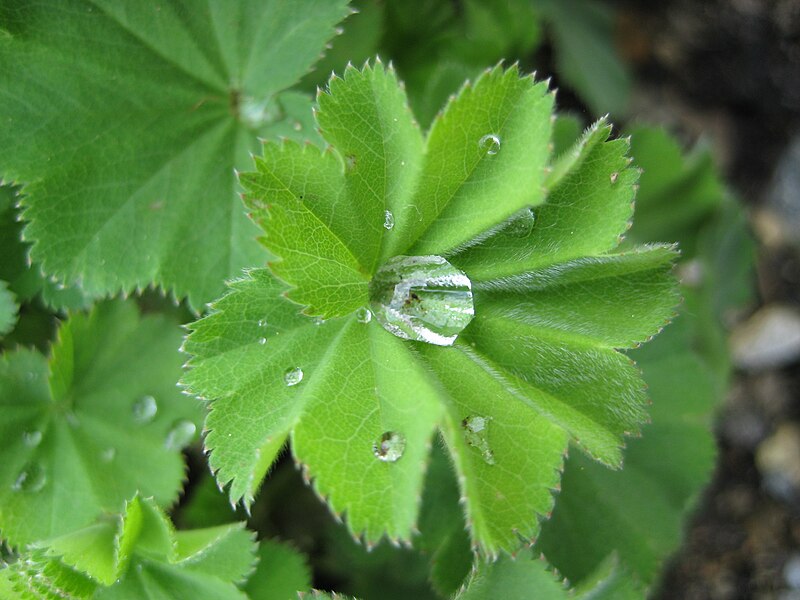
Lady's Mantle {Alchemilla vulgaris}


Photo from Jina Lee
Our Lady's Mantle ! When I musing stray
In leafy June along the mossy sward,
No flower that blooms more fixes my regard
Than thy green leaf, though simple its array;
For thou to me art as some minstrel's lay,
Depicting manners of the olden time,
When on Inch Cailliach's isle the convent chime
Summoned to Vespers at the close of day.
Tis pleasant 'mid the never-ending strife
Of this too busy, mammon-loving age,
When Nature's gentler charms so few engage,
To muse at leisure on the quiet life
Of earlier days, when every humble flower
Was known to all, and cherished as a dower.


~To Our Lady's Mantle from Sonnets and Miscellaneous Poems By James Inglis, 1853

Other Names: Common Lady's Mantle, Lion's Foot, Copan an Druichd, Bear's Foot, Falluing Mhuire,  Nine Hooks, Frauenmantle, Pied-de-lion.


Description: Lady's mantle is a lovely perennial that is a member of the rosaceae family. It can be found growing in the wild in England, Scotland, Canada, Greenland, and in much of Northern Europe and Asia.

It could be described as a demure plant, but as Ms Grieve said 'the rich form of its foliage and the beautiful shape of its clustering blossoms make it worthy of notice'.
From Wikimedia Commons
It is a low growing plant that doesn't grow to much more than 14 inches in height, and it has pretty yellowish-green flowers free of petals. It's prize feature is the wonderfully 'scalloped' leaves, which is said to resemble the Virgin Mary's cloak, from which it gets its name.

Warnings: As with all herbs, one should make sure to be thoroughly informed before ingesting them, and is best to do so under the guidance of a qualified healer.

Lady's mantle has reportedly been linked with liver damage in some cases, and many herbalists warn to women notify their health practitioner if they are pregnant or breastfeeding before ingesting the herb.

Cultivating: The natural habitat of lady's mantle is quite vast from meadows, sunny woodlands, by streams and other moist areas, as well as mountainous regions. It is a plant that does well in cooler climates and is generally thought to be suitable for hardiness zones 3 to 7.

Growing it from seed can be sometimes difficult, so it might be easier just to by seedlings or plants from a nursery. If you are going to grow it from seed, just keep in mind that it is quite slow to germinate.

Plant in the spring once there is no more chance of frost, in a spot that is anywhere from full sun to partial shade. It will do well in just about any type of soil, just make sure it is well-drained.

Mulching is a good idea, but lady's mantle is apparently quite drought-resistant. Also keep in mind that if it is doing well, it will drop plenty of seeds and spread, so you can always dead head the flowers if you want to have some control over this.

Some other plants that looks beautiful growing with lady's mantle are poppy, iris, fleabane, phlox, lily, and catmint.

Medicinal/Remedial Properties and Lore: Astringent, anti-inflammatory, diuretic, emmenagogue, febrifuge, sedative, styptic, tonic, vulnerary.

Lady's mantle has a long history of use for healing an assortment of ailments: from wounds and bruises, to vomiting and other stomach problems, as well as women's complaints.

One of the most interesting recommendations I found was from good old Culpeper who said, 'such women that have large breasts, causing them to grow less and hard, being both drank and outwordly applied'.

He also suggested its use for women who wished to conceive by drinking a tea, and claimed that it was great for wounds 'green, not suffering any corruption to remain behind, and cures all old sores, though fistulois and hollow'.

Onto Brother Aloysius, who recommended it for heavy bleeding, ulcerated lungs, dysentery, consumption, and ulcers. Like Culpeper, he also mentions in its helpfulness in the boob department, but this time for 'swollen' breasts.

Susun Weed proposes a tincture of fresh root as 'an excellent blood coagulant' and advocates its use for all types of 'female problems' {Wise Woman Herbal for the Childbearing Year}.

I can attest the helpfulness of lady's mantle when it comes to PMS and periods; I like making a tea with it paired with lemon balm {also great for these issues} because it does taste a little bitter and lemon balm has a more pleasant taste.


Photo from Aconcagua
Magical Properties and Lore:

The Latin name Alchemilla roughly translates 'small magical one', and was a plant of Alchemists who collected the dew found on the leaves for their workings.

In the book Folk-Lore of Women by Thomas Firminger Thiselton-Dyer (1906) it is said that lady's mantle 'was once in great repute with ladies; for, according to Hoffman, it had the power of restoring feminine beauty, however faded, to its early freshness'. Some women would collect dew found on the leaves on Bealtaine morning for this purpose.

Associated with the Virgin Mary, as the leaves are said to resemble her mantle, I also remember hearing a story when I was younger that the leaves were used as cloaks by the Good Folk.
 
Because of its use in women's health and healing, I have come to associate lady's mantle with the Goddesses Brigid {there is speculation by some folks that it is a herb historically tied to her} and Airmid.
 
According to some lady's mantle is connected to the planet and Goddess Venus, as well as other fertility, and Earth Goddesses. In some Swedish {and other Northern European traditions} it is placed under a woman's pillow if she wishes to dream of her future children; if worn in her hair during sex she would certainly become with child.

It was thought to ward off storms in Eastern Europe by burning it in a fire and letting the smoke go to the sky, or by hanging in windows and doors a farm would be kept safe from Nature's wrath.

In Polish-American Folklore by Deborah Anders Silverman she says that small wreaths of various types of herbs including lady's mantle are hung in homes to ward off evil spirits.
 
This is a herb that I like to use in tealeaf readings when the topic is one of love involving women {romantic, family, or platonic} and fertility of all types. I also think it is a splendid herb for love workings and for decorating on Bealtaine and Midsummer.

Other Uses:
The young leaves of lady's mantle are edible and can be served up raw or cooked, and the roots are also edible cooked.

It can also be used in beauty treatments! Below are some links to a few nifty recipes for you to try:

Hand lotion, facial steam, and bath vinegar

Hand mask

Sláinte!

Laurel

Tuesday, February 12, 2013

New Listings on Etsy

I have recently added a few new items onto the Unfettered Wood Etsy shop:


A nourishing offering powder for veggies and other edibles in your garden or on your farm.


A painted glass ball charm with various herbs and dirt inside of it that are associated with working with the deceased and protection. Made for those who practice necromancy or ancestor reverence.


Made with local beeswax and herbs to promote happiness, protection, abundance, love and harmony in the home.


Another charm made with local beeswax, along with some of my Ancestral Graveyard Dirt and herbs to encourage connections with ancestors or as a memento of love to remember those who have come before us.


Friday, January 18, 2013

Friday's Magic


{partially blurred for privacy}
For me Fridays are perfect for love magic and spellwork for romance, fertility, beauty, harmony, and to focus on increasing all the desirable things in life. Pictured is a blessing for a romantic relationship. The working was done for our anniversary a few months back, and it was started on a Friday during the full moon.
 
The candle was carved with Ogham script with our names and intent, and then was anointed with a specially created oil. Stuffed into the candle holder {which is actually a vase} are herbs associated with love and other qualities we want to see continued in our relationship, along with personal effects. After the candle was burnt over the course of nine days, it along with the items in the candle holder were put into a charm bag tied with a pink ribbon.

Sunday, December 9, 2012

European Mistletoe {Viscum Album}

{originally posted on the nefaeria blog in 2008, with a wee bit of updating}

photo by Rupert Ganzer
Along with conifers, poinsettias and holly, mistletoe is one of the plants most associated with the Yuletide season, so it is a perfect time to post about it I think.

There are other types of mistletoe, but for this post, I am focusing on the European or Common variety.

Other Names: Herbe de la Croix, All-Heal, Birdlime, Devil's Fuge, Mistletan.
 
Description: The European mistletoe is native to Britain, as well as to much of Europe. It is a hemiparastic evergreen that lives in mostly deciduous trees, and is compatible with at least 200 different host species.
 
It forms 'bushes' on the branches of trees, that are anywhere from 1.5 to 6 feet in diameter. The leaves are shaped like a tongue and they have white, round berries whose sticky juices have been noted to resemble semen.
 
Warnings: As with all herbs, one should make sure to be thoroughly informed before ingesting them, and is best to do so under the guidance of a qualified healer.
 
"Raw, unprocessed mistletoe is poisonous. Eating raw, unprocessed European mistletoe or American mistletoe can cause vomiting, seizures, a slowing of the heart rate, and even death." 
As well, they point out that in countries such as Germany have mistletoe that is available for therapeutic injection. There are potential side effects such as
"itching or redness in the area of the injection. Less commonly, side effects may include more extensive skin reactions, low-grade fevers, or flu-like symptoms. There have been very rare reports of more serious allergic reactions, such as difficulty breathing.'"
Also, avoid while pregnant, as it is known to cause contractions of the uterus.
 
Cultivating: Germination for the mistletoe usually begins once a bird's business is dropped on a its new host; the seeds sprout from the pile of bird poop, and then takes root in the bark of the tree.
 
The mistletoe mainly uses its host as a source of water and mineral nutrients, while its leaves do some photosynthesis. It usually bears fruit around the Winter Solstice.
 
According to Mrs. M Grieve, one could quite easily cultivate their own mistletoe simply by
"rubbing the berries on the smooth bark of the underside of the branches of trees till they adhere, or inserting them in clefts made for the purpose".
It is hardy to about a zone 5, and grows best in dappled shade. Brother Aloysius suggests that it be gathered in Autumn or Winter and that it should be dried and stored in sealed containers.
 
Medicinal/Remedial Properties and Lore: Antispasmodic, cardiac, cytostatic, diuretic, emmengogue, haemostat, hypotensive, narcotic, nervine, stimulant, tonic, vasodilator.
 
Culpeper said that
"misselto doth molify hard knots, tumours, and imposthumes...is a cephalic and nervine medicine, useful for convulsive fits, palsy, and vertigo."
Brother Aloysius recommended it for a variety of ailments including watery gall, jaundice, internal sores, convulsions and whopping cough.
 
Today mistletoe is mainly used for headaches, to lower blood pressure, to relieve anxiety and sleeplessness, and there are studies being done in it's effectiveness in combating cancer.
 
a holiday postcard, circa 1900
Magical/Spiritual Properties and Lore: It is said that Cesar saw Druids five days after the new moon following the Winter Solstice, climbing into oak trees and cutting mistletoe with golden sickles for ritual use. There are disagreements as to whether it was actually mistletoe or holly that they were cutting down.
 
According to Paul Beyerl's Master Book of Herbalism mistletoe is good for fertility, protection and visionary workings. For a Yule ritual in his book, people should toss a mistletoe berry into the hearth-fire to represent those personal things that one desires, as the sun comes back.
 
In some traditions, mistletoe is associated with solar deities because it bears fruit as the sun it at it's lowest point , and also lunar deities because of it's round, white fruit.
 
Once gathered, many sources say that it should not touch the ground, and it does indeed have many potential uses.
 
For protection, in Culpeper's Complete Herbal, he says that is can be hung around the neck to remedy witchcraft. Also, sprigs can be hung on doorways to protect houses from lightening and evil spirits; it can be placed by a cradle to avoid faeries {careful that little hands can't reach it!}; hung in a barn to protect a herd of cattle and buried in a field to protect a crop.
 
For this time of year, string up some mistletoe to get some kisses ;)
 
Where this custom actually originated from I am not sure, but there are a few that I have seen:
 
One involves the Norse God Baldr, who is killed by an arrow made of mistletoe, that is shot by Loki. After Baldr dies, Frigg cries and her tears become the white berries. In one version of the story, Baldr comes back to life, and Frigg is so happy that she blesses the mistletoe and says she will bestow a kiss to anyone who stands underneath it.
 
Under the Mistletoe, 1873
Another folktale says that if warring foes came under a tree with mistletoe on it, they would lay down their arms and kiss each other as a sign of peace.
 
I use mistletoe for various types of workings, including ones for protection, health/healing, divination, exorcism, fertility, romance, sexuality, and activities in the wild {hunting, camping, wildcrafting}.
 
Other Uses: It has long been thought that mistletoe is just a pest that not only kills off trees, but degrades entire habitats. But, according to a study done on the relationship between junipers and mistletoe, the mistletoe can actually play a role in protecting biodiversity.
 
Sláinte!
 
Laurel

Thursday, March 1, 2012

Sweetfern {Comptonia peregrina}


Other Names: Sweet-fern, Sweet Fern, Fern Gale, Spleenwort Bush, Sweet Ferry, Meadow Fern.

Description: The name 'Sweetfern' can be a tad bit misleading, since it is actually not a fern but a deciduous shrub. When one sees it, especially when young, it is understandable why it has 'fern' attached to its name; the foliage strongly resembles narrow fern leaves.

Sweetfern grows to about 3 feet high, its trunk is brown with a hint of red and can sometimes be quite hairy. The whole plant can smell very pleasant, especially the leaves when the are rubbed or bruised.

It is native to North America, and can be found growing in the wild from Quebec to the East, Saskatchewan in the West, to about North Carolina in the South. It is in the Myricaceae family, and the Bayberry is a close relative.

Warnings: As with all herbs, one should make sure to be thoroughly informed before ingesting them, and is best to do so under the guidance of a qualified healer.

photo by dogtooth77
Cultivating: Sweetfern can be found growing on hillsides, open fields, and in places where pine trees thrive. It does well to hardiness zone 3, and needs to be grown in full sun. It is drought resistant and prefers soil that is sandy, acidic and well-drained. It makes an excellent ground cover on land that has very poor quality soil!

You can buy plants at nurseries, but it maybe a little difficult to find. Another option is to propagate it through root cuttings, instead of seeds {unless you are up for an extreme challenge!}. Once Sweetfern has made itself at home, it needs very little upkeep and will spread very well via its rhizomes. It is a perennial and will mature around its third year.

One disease to be aware of is Sweetfern blister rust, which can also spread to various pines including Jack Pine, Scots Pine, and Ponderosa Pine.

Medicinal/Remedial Properties and Lore: Anti-inflammatory, aromatic, astringent, emollient, haemostat, stimulant, tonic.

Sweetfern has been used by both Natives and settlers to treat various different ailments. One of its most popular uses that is still appreciated today is as a tonic. All parts of the plant would be used, especially the top leaves in a tea to promote overall good health.

A decoction was used internally to treat dysentery, leucorrhea, rheumatism, diarrhoea, and internal bleeding. Henriette's Herbal recommends a dosage of from 1 to 4 fluid ounces, 3 or 4 times a day.

It is apparently quite effective when used topically to sooth Poison Ivy and other irritations, and can be used in this manner to treat rheumatism as well.

Magical/Spiritual Properties and Lore: According to Melvin Gilmore in Some Chippewa Uses of Plants,  Sweetfern was burnt as an 'incense' in religious ceremonies by some Indigenous poeple.

European settlers would sometimes use it in folk magic for love talismans and spells, and was sometimes planted in their farm fields in the hopes that some of its hardy properties would brush off on to their own crops.

photo by peganum
Other Uses: The nutlets are edible and apparently quite tasty! The leaves can be used to season foods, such as poultry or fish as well. Growing it in the garden is handy as it improves the soil by fixing the nitrogen, and is an excellent plant for wildlife. Deer, birds, and butterfly larvae will feed on Sweetfern, and birds such as grouse and killdeer will nest underneath it.

Sláinte!

Laurel