Showing posts with label fertility. Show all posts

Wednesday, May 22, 2013

The Merry Month of May

{cross posted at the nefaeria blog}

 
The last few weeks have been a busy juggle of celebrating Bealtaine and preparing for some pretty big changes that are just around the corner {more on that in another post}. To make it a little more challenging, some of my Bealtaine activities had been waiting for the weather to comply.

Even with the unpredictable weather though, I have been taking every chance to appreciate the natural beauty of this time of year.

lilacs
periwinkles
Yesterday I consecrated seeds, which will be planted on Friday along with my seedlings after I do a garden blessing. Some hardy annuals and colder weather crops such as lettuce and kale have already been planted.
 
My Bealtaine water and rowan wood for the year were collected a couple of weeks back and I have even got to harvest some herbs.
 
sweet woodruff, periwinkle flowers and wild ginger flowers
stinging nettle
There has been some crafting going on around here too, including a candle to represent my hearth, which was ritually lit after last year's candle smothered. With a bit of luck, this candle will last me until next Bealtaine.
 

Near the end of April my "seasonal altar" was set up for Bealtaine, or perhaps better described as a shrine to Flidais and the wild critters. Over the course of the last few weeks daily devotionals and offerings were made.


For the "big do" I created some May boughs and a May bush and made nettle soup, bannocks and butter.
 

The house was sained and a Bealtaine blessing was said and our "hearth" was smothered and re-lit.
 

I hope that everyone else is having a lovely May!

Sláinte!

Laurel

Thursday, April 18, 2013

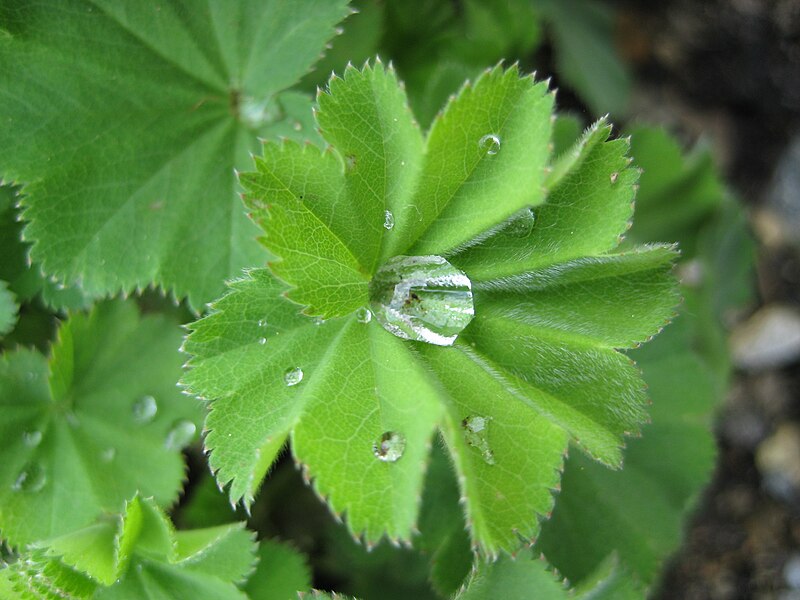
Lady's Mantle {Alchemilla vulgaris}


Photo from Jina Lee
Our Lady's Mantle ! When I musing stray
In leafy June along the mossy sward,
No flower that blooms more fixes my regard
Than thy green leaf, though simple its array;
For thou to me art as some minstrel's lay,
Depicting manners of the olden time,
When on Inch Cailliach's isle the convent chime
Summoned to Vespers at the close of day.
Tis pleasant 'mid the never-ending strife
Of this too busy, mammon-loving age,
When Nature's gentler charms so few engage,
To muse at leisure on the quiet life
Of earlier days, when every humble flower
Was known to all, and cherished as a dower.


~To Our Lady's Mantle from Sonnets and Miscellaneous Poems By James Inglis, 1853

Other Names: Common Lady's Mantle, Lion's Foot, Copan an Druichd, Bear's Foot, Falluing Mhuire,  Nine Hooks, Frauenmantle, Pied-de-lion.


Description: Lady's mantle is a lovely perennial that is a member of the rosaceae family. It can be found growing in the wild in England, Scotland, Canada, Greenland, and in much of Northern Europe and Asia.

It could be described as a demure plant, but as Ms Grieve said 'the rich form of its foliage and the beautiful shape of its clustering blossoms make it worthy of notice'.
From Wikimedia Commons
It is a low growing plant that doesn't grow to much more than 14 inches in height, and it has pretty yellowish-green flowers free of petals. It's prize feature is the wonderfully 'scalloped' leaves, which is said to resemble the Virgin Mary's cloak, from which it gets its name.

Warnings: As with all herbs, one should make sure to be thoroughly informed before ingesting them, and is best to do so under the guidance of a qualified healer.

Lady's mantle has reportedly been linked with liver damage in some cases, and many herbalists warn to women notify their health practitioner if they are pregnant or breastfeeding before ingesting the herb.

Cultivating: The natural habitat of lady's mantle is quite vast from meadows, sunny woodlands, by streams and other moist areas, as well as mountainous regions. It is a plant that does well in cooler climates and is generally thought to be suitable for hardiness zones 3 to 7.

Growing it from seed can be sometimes difficult, so it might be easier just to by seedlings or plants from a nursery. If you are going to grow it from seed, just keep in mind that it is quite slow to germinate.

Plant in the spring once there is no more chance of frost, in a spot that is anywhere from full sun to partial shade. It will do well in just about any type of soil, just make sure it is well-drained.

Mulching is a good idea, but lady's mantle is apparently quite drought-resistant. Also keep in mind that if it is doing well, it will drop plenty of seeds and spread, so you can always dead head the flowers if you want to have some control over this.

Some other plants that looks beautiful growing with lady's mantle are poppy, iris, fleabane, phlox, lily, and catmint.

Medicinal/Remedial Properties and Lore: Astringent, anti-inflammatory, diuretic, emmenagogue, febrifuge, sedative, styptic, tonic, vulnerary.

Lady's mantle has a long history of use for healing an assortment of ailments: from wounds and bruises, to vomiting and other stomach problems, as well as women's complaints.

One of the most interesting recommendations I found was from good old Culpeper who said, 'such women that have large breasts, causing them to grow less and hard, being both drank and outwordly applied'.

He also suggested its use for women who wished to conceive by drinking a tea, and claimed that it was great for wounds 'green, not suffering any corruption to remain behind, and cures all old sores, though fistulois and hollow'.

Onto Brother Aloysius, who recommended it for heavy bleeding, ulcerated lungs, dysentery, consumption, and ulcers. Like Culpeper, he also mentions in its helpfulness in the boob department, but this time for 'swollen' breasts.

Susun Weed proposes a tincture of fresh root as 'an excellent blood coagulant' and advocates its use for all types of 'female problems' {Wise Woman Herbal for the Childbearing Year}.

I can attest the helpfulness of lady's mantle when it comes to PMS and periods; I like making a tea with it paired with lemon balm {also great for these issues} because it does taste a little bitter and lemon balm has a more pleasant taste.


Photo from Aconcagua
Magical Properties and Lore:

The Latin name Alchemilla roughly translates 'small magical one', and was a plant of Alchemists who collected the dew found on the leaves for their workings.

In the book Folk-Lore of Women by Thomas Firminger Thiselton-Dyer (1906) it is said that lady's mantle 'was once in great repute with ladies; for, according to Hoffman, it had the power of restoring feminine beauty, however faded, to its early freshness'. Some women would collect dew found on the leaves on Bealtaine morning for this purpose.

Associated with the Virgin Mary, as the leaves are said to resemble her mantle, I also remember hearing a story when I was younger that the leaves were used as cloaks by the Good Folk.
 
Because of its use in women's health and healing, I have come to associate lady's mantle with the Goddesses Brigid {there is speculation by some folks that it is a herb historically tied to her} and Airmid.
 
According to some lady's mantle is connected to the planet and Goddess Venus, as well as other fertility, and Earth Goddesses. In some Swedish {and other Northern European traditions} it is placed under a woman's pillow if she wishes to dream of her future children; if worn in her hair during sex she would certainly become with child.

It was thought to ward off storms in Eastern Europe by burning it in a fire and letting the smoke go to the sky, or by hanging in windows and doors a farm would be kept safe from Nature's wrath.

In Polish-American Folklore by Deborah Anders Silverman she says that small wreaths of various types of herbs including lady's mantle are hung in homes to ward off evil spirits.
 
This is a herb that I like to use in tealeaf readings when the topic is one of love involving women {romantic, family, or platonic} and fertility of all types. I also think it is a splendid herb for love workings and for decorating on Bealtaine and Midsummer.

Other Uses:
The young leaves of lady's mantle are edible and can be served up raw or cooked, and the roots are also edible cooked.

It can also be used in beauty treatments! Below are some links to a few nifty recipes for you to try:

Hand lotion, facial steam, and bath vinegar

Hand mask

Sláinte!

Laurel

Tuesday, February 19, 2013

A Few More New Etsy Listings...


Made with vulva-shaped milkweed pods, beeswax, rose pedals, wee seashells and herbs assoicated with abundance and fertility.


A  nourishing offering powder for wild plants and nature spirits.


A mix of lovely annuals, biennials, and perennials.


A glass ball charm with various herbs associated with happiness, peace, abundance and protection.
 

Friday, January 18, 2013

Friday's Magic


{partially blurred for privacy}
For me Fridays are perfect for love magic and spellwork for romance, fertility, beauty, harmony, and to focus on increasing all the desirable things in life. Pictured is a blessing for a romantic relationship. The working was done for our anniversary a few months back, and it was started on a Friday during the full moon.
 
The candle was carved with Ogham script with our names and intent, and then was anointed with a specially created oil. Stuffed into the candle holder {which is actually a vase} are herbs associated with love and other qualities we want to see continued in our relationship, along with personal effects. After the candle was burnt over the course of nine days, it along with the items in the candle holder were put into a charm bag tied with a pink ribbon.

Sunday, December 9, 2012

European Mistletoe {Viscum Album}

{originally posted on the nefaeria blog in 2008, with a wee bit of updating}

photo by Rupert Ganzer
Along with conifers, poinsettias and holly, mistletoe is one of the plants most associated with the Yuletide season, so it is a perfect time to post about it I think.

There are other types of mistletoe, but for this post, I am focusing on the European or Common variety.

Other Names: Herbe de la Croix, All-Heal, Birdlime, Devil's Fuge, Mistletan.
 
Description: The European mistletoe is native to Britain, as well as to much of Europe. It is a hemiparastic evergreen that lives in mostly deciduous trees, and is compatible with at least 200 different host species.
 
It forms 'bushes' on the branches of trees, that are anywhere from 1.5 to 6 feet in diameter. The leaves are shaped like a tongue and they have white, round berries whose sticky juices have been noted to resemble semen.
 
Warnings: As with all herbs, one should make sure to be thoroughly informed before ingesting them, and is best to do so under the guidance of a qualified healer.
 
"Raw, unprocessed mistletoe is poisonous. Eating raw, unprocessed European mistletoe or American mistletoe can cause vomiting, seizures, a slowing of the heart rate, and even death." 
As well, they point out that in countries such as Germany have mistletoe that is available for therapeutic injection. There are potential side effects such as
"itching or redness in the area of the injection. Less commonly, side effects may include more extensive skin reactions, low-grade fevers, or flu-like symptoms. There have been very rare reports of more serious allergic reactions, such as difficulty breathing.'"
Also, avoid while pregnant, as it is known to cause contractions of the uterus.
 
Cultivating: Germination for the mistletoe usually begins once a bird's business is dropped on a its new host; the seeds sprout from the pile of bird poop, and then takes root in the bark of the tree.
 
The mistletoe mainly uses its host as a source of water and mineral nutrients, while its leaves do some photosynthesis. It usually bears fruit around the Winter Solstice.
 
According to Mrs. M Grieve, one could quite easily cultivate their own mistletoe simply by
"rubbing the berries on the smooth bark of the underside of the branches of trees till they adhere, or inserting them in clefts made for the purpose".
It is hardy to about a zone 5, and grows best in dappled shade. Brother Aloysius suggests that it be gathered in Autumn or Winter and that it should be dried and stored in sealed containers.
 
Medicinal/Remedial Properties and Lore: Antispasmodic, cardiac, cytostatic, diuretic, emmengogue, haemostat, hypotensive, narcotic, nervine, stimulant, tonic, vasodilator.
 
Culpeper said that
"misselto doth molify hard knots, tumours, and imposthumes...is a cephalic and nervine medicine, useful for convulsive fits, palsy, and vertigo."
Brother Aloysius recommended it for a variety of ailments including watery gall, jaundice, internal sores, convulsions and whopping cough.
 
Today mistletoe is mainly used for headaches, to lower blood pressure, to relieve anxiety and sleeplessness, and there are studies being done in it's effectiveness in combating cancer.
 
a holiday postcard, circa 1900
Magical/Spiritual Properties and Lore: It is said that Cesar saw Druids five days after the new moon following the Winter Solstice, climbing into oak trees and cutting mistletoe with golden sickles for ritual use. There are disagreements as to whether it was actually mistletoe or holly that they were cutting down.
 
According to Paul Beyerl's Master Book of Herbalism mistletoe is good for fertility, protection and visionary workings. For a Yule ritual in his book, people should toss a mistletoe berry into the hearth-fire to represent those personal things that one desires, as the sun comes back.
 
In some traditions, mistletoe is associated with solar deities because it bears fruit as the sun it at it's lowest point , and also lunar deities because of it's round, white fruit.
 
Once gathered, many sources say that it should not touch the ground, and it does indeed have many potential uses.
 
For protection, in Culpeper's Complete Herbal, he says that is can be hung around the neck to remedy witchcraft. Also, sprigs can be hung on doorways to protect houses from lightening and evil spirits; it can be placed by a cradle to avoid faeries {careful that little hands can't reach it!}; hung in a barn to protect a herd of cattle and buried in a field to protect a crop.
 
For this time of year, string up some mistletoe to get some kisses ;)
 
Where this custom actually originated from I am not sure, but there are a few that I have seen:
 
One involves the Norse God Baldr, who is killed by an arrow made of mistletoe, that is shot by Loki. After Baldr dies, Frigg cries and her tears become the white berries. In one version of the story, Baldr comes back to life, and Frigg is so happy that she blesses the mistletoe and says she will bestow a kiss to anyone who stands underneath it.
 
Under the Mistletoe, 1873
Another folktale says that if warring foes came under a tree with mistletoe on it, they would lay down their arms and kiss each other as a sign of peace.
 
I use mistletoe for various types of workings, including ones for protection, health/healing, divination, exorcism, fertility, romance, sexuality, and activities in the wild {hunting, camping, wildcrafting}.
 
Other Uses: It has long been thought that mistletoe is just a pest that not only kills off trees, but degrades entire habitats. But, according to a study done on the relationship between junipers and mistletoe, the mistletoe can actually play a role in protecting biodiversity.
 
Sláinte!
 
Laurel

Sunday, October 21, 2012

Cross Quarter Waters

Tobernault Holy Well grotto in Sligo Co, Ireland. Photo by BA_Banks
During the cross quarters {to many neo pagans these are called the high sabbats} there are traditions of collecting water, whether it be from dew on a leaf, a holy well, or by leaving a bowl out to collect rain. Below you will see some of these traditions found in Ireland, Scotland & the Isle of Man, and I will share some of the ways that I collect water and what I use it for. If I am able to collect enough water, I will keep it in clean corked bottles {I usually re-use old whiskey bottles}.

Imbolc
 
There are a couple traditions that I have come across involving water for Imbolc. Sometimes water would be left outdoors or by the hearth on the Eve of Imbolc for Brigid to bless, which would be used for healing and fertility. Water was also collected from holy wells associated with Brigid which would be used to bless the household and livestock.
 
Since I do not live by a holy well, I will collect clean snow and leave it in a bowl for Brigid to bless. I use this water for house blessings and clearings {or saining}, as well as in purification rituals and for workings involving women's sexual healing and fertility.

Bealtaine

Many folks would visit holy wells and sacred water sites around the beginning of May to drink and bathe in the waters for healing or to take some home with them for luck and protection. The first "cream" of the well or spring collected for Bealtaine was thought to be the most potent. Dew was also collected and used by women and girls to bring beauty; both dew and the first cream was also used for blessing the milk cows and butter churns.
 
On Bealtaine morning before sunrise, I will collect dew {especially from lady's mantle} and bring in the bowls I left out to collect dew and/or rainwater. Some years I am also lucky enough to share some of the first "cream" of a friend's well. I use this water for consecrating seed, blessing livestock and farm buildings, as well as other agriculture rituals. The water is also useful for lust and romance workings.
 
Lughnasadh

It seems that people would generally go to sacred water sites and take care of business there, instead of bringing the water home with them. Sometimes horses and other livestock were put in the water for blessings, or people would immerse themselves and drink the water to heal all sorts of ailments.
 
I will collect rainwater {or river water if there is no rain} which is mainly used for harvest/reaping blessings; since Lughnasadh was historically a time for making contracts and paying taxes, I will also use it in workings involving engagements, marriage, oaths, business and finances, as well as other commitments. 

Samhain

I haven't come across many traditions involving water for Samhain, although the Tairis site mentions that water from a wise woman was sometimes used to bless folks for protection from the evil eye. If you happen to know of any traditions, please feel free to share them in the comment section!

On the Eve of Samhain I will leave out bowls to collect rainwater {there is no shortage at this time of year!}, which is used for workings involving divination, death and working with ancestors, protection against malignant forces and magic, and for hexing.

Sláinte!

Laurel

Thursday, March 1, 2012

Sweetfern {Comptonia peregrina}


Other Names: Sweet-fern, Sweet Fern, Fern Gale, Spleenwort Bush, Sweet Ferry, Meadow Fern.

Description: The name 'Sweetfern' can be a tad bit misleading, since it is actually not a fern but a deciduous shrub. When one sees it, especially when young, it is understandable why it has 'fern' attached to its name; the foliage strongly resembles narrow fern leaves.

Sweetfern grows to about 3 feet high, its trunk is brown with a hint of red and can sometimes be quite hairy. The whole plant can smell very pleasant, especially the leaves when the are rubbed or bruised.

It is native to North America, and can be found growing in the wild from Quebec to the East, Saskatchewan in the West, to about North Carolina in the South. It is in the Myricaceae family, and the Bayberry is a close relative.

Warnings: As with all herbs, one should make sure to be thoroughly informed before ingesting them, and is best to do so under the guidance of a qualified healer.

photo by dogtooth77
Cultivating: Sweetfern can be found growing on hillsides, open fields, and in places where pine trees thrive. It does well to hardiness zone 3, and needs to be grown in full sun. It is drought resistant and prefers soil that is sandy, acidic and well-drained. It makes an excellent ground cover on land that has very poor quality soil!

You can buy plants at nurseries, but it maybe a little difficult to find. Another option is to propagate it through root cuttings, instead of seeds {unless you are up for an extreme challenge!}. Once Sweetfern has made itself at home, it needs very little upkeep and will spread very well via its rhizomes. It is a perennial and will mature around its third year.

One disease to be aware of is Sweetfern blister rust, which can also spread to various pines including Jack Pine, Scots Pine, and Ponderosa Pine.

Medicinal/Remedial Properties and Lore: Anti-inflammatory, aromatic, astringent, emollient, haemostat, stimulant, tonic.

Sweetfern has been used by both Natives and settlers to treat various different ailments. One of its most popular uses that is still appreciated today is as a tonic. All parts of the plant would be used, especially the top leaves in a tea to promote overall good health.

A decoction was used internally to treat dysentery, leucorrhea, rheumatism, diarrhoea, and internal bleeding. Henriette's Herbal recommends a dosage of from 1 to 4 fluid ounces, 3 or 4 times a day.

It is apparently quite effective when used topically to sooth Poison Ivy and other irritations, and can be used in this manner to treat rheumatism as well.

Magical/Spiritual Properties and Lore: According to Melvin Gilmore in Some Chippewa Uses of Plants,  Sweetfern was burnt as an 'incense' in religious ceremonies by some Indigenous poeple.

European settlers would sometimes use it in folk magic for love talismans and spells, and was sometimes planted in their farm fields in the hopes that some of its hardy properties would brush off on to their own crops.

photo by peganum
Other Uses: The nutlets are edible and apparently quite tasty! The leaves can be used to season foods, such as poultry or fish as well. Growing it in the garden is handy as it improves the soil by fixing the nitrogen, and is an excellent plant for wildlife. Deer, birds, and butterfly larvae will feed on Sweetfern, and birds such as grouse and killdeer will nest underneath it.

Sláinte!

Laurel