Showing posts with label folk healing. Show all posts

Sunday, December 15, 2019

Healing with the Aid of Ancestors {Ritual and Herbal Powder Recipe}


I had been inspired by two events and two plants this year to finally do an Ancestral healing ritual this past Samhain. This is something that I had been wishing to do for a few years now, and had worked my way towards it on some counts, but also had been avoiding doing so, not ready to face or let go of some pain and anger. 

The first event of inspiration happened when I was at Tlachtga/Hill of Ward this past Bealtaine, after hearing the story of Tlachtga, I knew that I had wanted to do something on Samhain to honour her. In her story she is deeply betrayed by her jealous father, which lead to her rape and impregnation, causing her to birth three sons, which also ultimately lead to her death. But instead of her last words being of vengeance and hatred, they were of hope and love, the naming of her three sons: Cuma, Muach and Doirb. And as long as those names are remembered, Ireland and her people shall be safe from catastrophe. To me Tlachtga is a figure of strength and sovereignty; not necessarily encouraging forgiveness and most certainly not forgetting, but urging one forward to live their full potential, irregardless of what life throws at them. Also while at the Hill of Ward, I had my first of many experiences during my time in Ireland of communing with various nature spirits, this time being with Stinging Nettle. Already an ally, I was reminded of the many lessons that this plant can teach. One of them being that just like the pain one can get through harvesting them, it could be well worth going through the experience for the potential of nourishment and healing that both the plant and painful experience can bring. For only through such experiences can we truly gain the insights needed to heal ourselves and help others with the same. 

The second event of inspiration came this past summer during a get together up north, while visiting our family cemetery in a small village. The whole place was carpeted by beautiful Selfheal/Heal-all, another beloved plant ally. I harvested some, knowing that it would be perfect for helping heal family and ancestral wounds. 

While I did initialize the healing on Samhain, it is a work in progress, so this is something that I continue to do. I suppose it could be said that this has been incorporated into my devotional work with my Ancestors, hopefully that is mutually beneficial for both the living and the dead. 

I've decided to share some of that here, in case others are looking to do similar work with the aid of their own Ancestors.

Ancestral Herbal Healing Powder


A powder like this could easily be used in charms, in an incense, or as I have done and made it for adding to candles for ritual use. *Wearing gloves would be a good idea while making this, as some of the ingredients can be toxic. This was made on the full moon before Samhain, which happened to be a Sunday, to me a great time for healing work. I spent a good long while grinding everything in a mortar and pestle, in a meditative state focusing on healing. The mixture was then left under the light of the full moon to be blessed for nine days.

Stinging Nettle
Selfheal
Ancestral Rose Thorns
Wild Rose
Cedar
Tansy {can be toxic}
Apple Leaves
Meadowsweet
Thyme
Bleeding Hearts {can be toxic}
Mullein
Heather
Linden Leaf and Flower
Forget-Me-Nots

Ancestral Healing Ritual


I carved on a black candle in Ogham down three separate sides "Clann" {Family}, "Shinsir" {Ancestors} and "Leighgeas" {Healing}, and over each carving placed three personal effects to consecrate the candle within the Three Realms: blood {Talam/Land}, saliva {Muir/Sea} and breath {Nem/Sky}. Then on each carving I rubbed some of the herbal powder from above, three times on each.

The candle was then placed in a silver bowl of Ancestral graveyard dirt, surrounded by three poppy pods, one at each point of the Ogham carving. Under this is kept names and situations being focused on for healing. Before being lit, the candle was anointed with nine drops of a healing oil, and sprinkled with more of the herbal powder. This is something I do every time before the candle is lit for a working.

Of course before beginning the ritual, I always leave offerings to those who I am asking help from, which I encourage everyone to do. During the ritual there are prayers, meditation and often divination as well, which I also encourage others to do, tailored to their own needs and personal practices. 

*********
It's never an easy thing, the process of healing. For those on that same journey, I hope that this post might be of some use to to you. 

Thursday, April 24, 2014

Gaelic Folk Healing: Staunching Blood

This is my first entry on Gaelic Folk Healing, this one covers some of the traditional lore and practices to stop bleeding. This post is for the sake of exploration and is not intended to give medical advice!
*********
 
Blood Drop by Mattia Belletti

Is beannuighthe ainm an fhir a sgoilt croidhe an làoigh ghil ;
Is maith an nidh thainic as, fuil, fion, agus fioruisge.
An ainm a n-Athar, stop an fhuil ; Sancti, taraidh dà chobhair.
Spiritus Sancte, stop an fuil ta ag teacht go treun.
 
~ Ortha Coisgthe Fola
 
 
There were healers who reported had the gift to stop bleeding, through the use of prayer or words of power. These gifts were sometimes thought to be passed through blood line or taught from one person to another. In some parts of Scotland, it was thought to be most effective when a male taught a female and a female taught a male these incantations. {Survival in Beliefs Among the Celts by George Henderson}.
 
In the Third Manx Scrapbook there is an instance of a Peel man named Gawne who was on a boat with a man bleeding to death and Gawne "saved his life without touching him, merely using a spoken formula." This gift was not only used on humans, but animals as well.
 
Also found in the Third Manx Scrapbook are accounts of a man named Jack Corlett of Ramsey who was thought to be especially gifted in staunching the bleeding of animals. Of this the author says:
 
"A friend of mine when about 11 years old watched a farrier cut a tumour out of the vaginal passage of a neighbour's cow near Leodas in Andreas. It was a serious operation, and the farrier refused to begin it until Jack Corlett came. As soon as the growth was cut out Corlett muttered his charm, and the bleeding ceased. This my friend saw, he says, with his own eyes."
 
There are few other accounts of people who supposed had this gift in the book which can be read here.

Some lore insists that to be able to stop bleeding on an individual, the healer must know the name of the person. An example of this is found in a story from Aultbea, Scotland where a blood-charmer named Ian Ban had trouble stopping the bleeding of a man injured at a wedding. It wasn't until another blood-charmer present spoke the victim's true name that the bleeding had stopped.

Not everyone was lucky enough to have someone around who supposedly had the power stop blood on command. Those people would turn to other means to staunch bleeding.

In Transactions of the Gaelic Society, Vol. 14 a cure to stop bleeding that was used in the Scottish Highlands was boiling a bowlful of blood into a powder, which was then given to the bleeding victim to swallow.
 
A cure reportedly used to stop bleeding in Ireland was cobwebs:
 
"This knowledge about cobwebs can be traced back to a medical manuscript that was transcribed from Latin into Irish by an Irish Liaig, T.Ó Cuinn in 1415. This manuscript is a compilation in Irish of various Latin works that were in general use by medical people in the middle- ages. The Tadhg Ó Cuinn manuscript has this to say about cobwebs:
 
Tele rania: i.e. the spider’s web; cold and dry; it has the retentive virtue; it stops the bleeding of wounds, and it heals as we have said.’ " {The Thread that Could Not Be Broken: Overview of Irish Traditional Medicine by Rosari Kingston}.

Lady Augusta Wilde cites in Ancient Cures, Charms and Usages of Ireland a prayer that is used in conjunction with scarlet coloured yarn to stop bleeding. The yarn was tied tightly around the neck and wrists {definitely not recommended!!!} while this prayer was said:

"There came a man from Bethlehem to be baptized in the river Jordan ;
 but the water was so muddy that it stopped flowing.
So let the blood ! So let the blood !
 Let it stop flowing in the name of Jesus, and by the power of Christ !"
 
Frogs and toads were used to stop bleeding in Scotland; living toads were brought face-to-face with a person to stop a nose bleed, and the ashes of a frog were administered to stop more serious bleeds {Healing Threads by Mary Beith}.
 
A charm called a "toad-stone" is noted in Scottish Charms and Amulets by Geoffrey Black that apparently was used to stop bleeding. It was a small black oval-shaped stone that was placed on a wound and the following incantation was said:
 
"The water’s mud [?wud] and runs aflood,
And so does thy blood.
God bade it stand and so it did.
In the name of the Father, Son, and Holy Ghost, stand blood!"
 
Many different herbs were also used to stop bleeding, and there are a few named Lus na fola/Lus na fala {"herb of blood/blood weed"} including Yarrow{Achillea millefolium}, Shepherd's Purse{Capsella bursa-pastoris}, and Saint John's Wort {Hypericum perforatum}. Often these herbs would be used in ointments to be applied to wounds to stop bleeding and to promote healing in general.
 
To stop nose-bleeds Mary Beith mentions two folk cures used in the Scottish Highlands: a Broom{Cytisus scoparius} bundle was tied around a patient's neck or a seaweed called Linarich {Ulva lactuca ? } was placed on the forehead and temples. She also raises Stinging Nettle {Urtica dioica} poultices being used for minor bleeding, as well and Puffballs {Bovista nigrescens} and fresh Plantain {Plantago major} to staunch small amounts of blood flow.
 
*********

If any readers happen to know of other Gaelic folk cures and lore for staunching blood, please feel free to share them!

Sláinte!

Laurel


Monday, July 1, 2013

Harvesting & Giving Thanks for Healing Herbs

 
Hello dear readers, I hope that everyone is having a lovely summer so far!
 
One of the most exciting times in my garden for me is when I get to harvest herbs in early summer. Last year I did a more in-depth post on some of the rituals that I do around this time for those who are interested. This post will just mostly be photos.
 
The lovely bounty.
 
My Midsummer shrine dedicated to Airmid & honeybees.
 
Offering stones, double pink columbine and hand-rolled beeswax candles.
 
 
Bee artwork done by Amanda Clark.
 
A vessel I made for healing.
In other news, I am getting everything together for a Lughnasadh giveaway, so stay tuned for that.

Sláinte!

Laurel

Thursday, April 18, 2013

Lady's Mantle {Alchemilla vulgaris}


Photo from Jina Lee
Our Lady's Mantle ! When I musing stray
In leafy June along the mossy sward,
No flower that blooms more fixes my regard
Than thy green leaf, though simple its array;
For thou to me art as some minstrel's lay,
Depicting manners of the olden time,
When on Inch Cailliach's isle the convent chime
Summoned to Vespers at the close of day.
Tis pleasant 'mid the never-ending strife
Of this too busy, mammon-loving age,
When Nature's gentler charms so few engage,
To muse at leisure on the quiet life
Of earlier days, when every humble flower
Was known to all, and cherished as a dower.


~To Our Lady's Mantle from Sonnets and Miscellaneous Poems By James Inglis, 1853

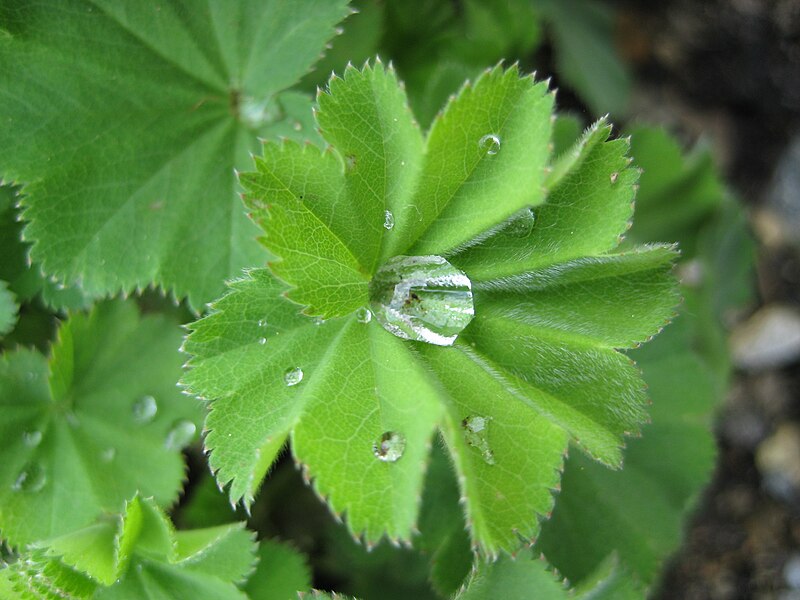
Other Names: Common Lady's Mantle, Lion's Foot, Copan an Druichd, Bear's Foot, Falluing Mhuire,  Nine Hooks, Frauenmantle, Pied-de-lion.


Description: Lady's mantle is a lovely perennial that is a member of the rosaceae family. It can be found growing in the wild in England, Scotland, Canada, Greenland, and in much of Northern Europe and Asia.

It could be described as a demure plant, but as Ms Grieve said 'the rich form of its foliage and the beautiful shape of its clustering blossoms make it worthy of notice'.
From Wikimedia Commons
It is a low growing plant that doesn't grow to much more than 14 inches in height, and it has pretty yellowish-green flowers free of petals. It's prize feature is the wonderfully 'scalloped' leaves, which is said to resemble the Virgin Mary's cloak, from which it gets its name.

Warnings: As with all herbs, one should make sure to be thoroughly informed before ingesting them, and is best to do so under the guidance of a qualified healer.

Lady's mantle has reportedly been linked with liver damage in some cases, and many herbalists warn to women notify their health practitioner if they are pregnant or breastfeeding before ingesting the herb.

Cultivating: The natural habitat of lady's mantle is quite vast from meadows, sunny woodlands, by streams and other moist areas, as well as mountainous regions. It is a plant that does well in cooler climates and is generally thought to be suitable for hardiness zones 3 to 7.

Growing it from seed can be sometimes difficult, so it might be easier just to by seedlings or plants from a nursery. If you are going to grow it from seed, just keep in mind that it is quite slow to germinate.

Plant in the spring once there is no more chance of frost, in a spot that is anywhere from full sun to partial shade. It will do well in just about any type of soil, just make sure it is well-drained.

Mulching is a good idea, but lady's mantle is apparently quite drought-resistant. Also keep in mind that if it is doing well, it will drop plenty of seeds and spread, so you can always dead head the flowers if you want to have some control over this.

Some other plants that looks beautiful growing with lady's mantle are poppy, iris, fleabane, phlox, lily, and catmint.

Medicinal/Remedial Properties and Lore: Astringent, anti-inflammatory, diuretic, emmenagogue, febrifuge, sedative, styptic, tonic, vulnerary.

Lady's mantle has a long history of use for healing an assortment of ailments: from wounds and bruises, to vomiting and other stomach problems, as well as women's complaints.

One of the most interesting recommendations I found was from good old Culpeper who said, 'such women that have large breasts, causing them to grow less and hard, being both drank and outwordly applied'.

He also suggested its use for women who wished to conceive by drinking a tea, and claimed that it was great for wounds 'green, not suffering any corruption to remain behind, and cures all old sores, though fistulois and hollow'.

Onto Brother Aloysius, who recommended it for heavy bleeding, ulcerated lungs, dysentery, consumption, and ulcers. Like Culpeper, he also mentions in its helpfulness in the boob department, but this time for 'swollen' breasts.

Susun Weed proposes a tincture of fresh root as 'an excellent blood coagulant' and advocates its use for all types of 'female problems' {Wise Woman Herbal for the Childbearing Year}.

I can attest the helpfulness of lady's mantle when it comes to PMS and periods; I like making a tea with it paired with lemon balm {also great for these issues} because it does taste a little bitter and lemon balm has a more pleasant taste.


Photo from Aconcagua
Magical Properties and Lore:

The Latin name Alchemilla roughly translates 'small magical one', and was a plant of Alchemists who collected the dew found on the leaves for their workings.

In the book Folk-Lore of Women by Thomas Firminger Thiselton-Dyer (1906) it is said that lady's mantle 'was once in great repute with ladies; for, according to Hoffman, it had the power of restoring feminine beauty, however faded, to its early freshness'. Some women would collect dew found on the leaves on Bealtaine morning for this purpose.

Associated with the Virgin Mary, as the leaves are said to resemble her mantle, I also remember hearing a story when I was younger that the leaves were used as cloaks by the Good Folk.
 
Because of its use in women's health and healing, I have come to associate lady's mantle with the Goddesses Brigid {there is speculation by some folks that it is a herb historically tied to her} and Airmid.
 
According to some lady's mantle is connected to the planet and Goddess Venus, as well as other fertility, and Earth Goddesses. In some Swedish {and other Northern European traditions} it is placed under a woman's pillow if she wishes to dream of her future children; if worn in her hair during sex she would certainly become with child.

It was thought to ward off storms in Eastern Europe by burning it in a fire and letting the smoke go to the sky, or by hanging in windows and doors a farm would be kept safe from Nature's wrath.

In Polish-American Folklore by Deborah Anders Silverman she says that small wreaths of various types of herbs including lady's mantle are hung in homes to ward off evil spirits.
 
This is a herb that I like to use in tealeaf readings when the topic is one of love involving women {romantic, family, or platonic} and fertility of all types. I also think it is a splendid herb for love workings and for decorating on Bealtaine and Midsummer.

Other Uses:
The young leaves of lady's mantle are edible and can be served up raw or cooked, and the roots are also edible cooked.

It can also be used in beauty treatments! Below are some links to a few nifty recipes for you to try:

Hand lotion, facial steam, and bath vinegar

Hand mask

Sláinte!

Laurel

Sunday, December 9, 2012

European Mistletoe {Viscum Album}

{originally posted on the nefaeria blog in 2008, with a wee bit of updating}

photo by Rupert Ganzer
Along with conifers, poinsettias and holly, mistletoe is one of the plants most associated with the Yuletide season, so it is a perfect time to post about it I think.

There are other types of mistletoe, but for this post, I am focusing on the European or Common variety.

Other Names: Herbe de la Croix, All-Heal, Birdlime, Devil's Fuge, Mistletan.
 
Description: The European mistletoe is native to Britain, as well as to much of Europe. It is a hemiparastic evergreen that lives in mostly deciduous trees, and is compatible with at least 200 different host species.
 
It forms 'bushes' on the branches of trees, that are anywhere from 1.5 to 6 feet in diameter. The leaves are shaped like a tongue and they have white, round berries whose sticky juices have been noted to resemble semen.
 
Warnings: As with all herbs, one should make sure to be thoroughly informed before ingesting them, and is best to do so under the guidance of a qualified healer.
 
"Raw, unprocessed mistletoe is poisonous. Eating raw, unprocessed European mistletoe or American mistletoe can cause vomiting, seizures, a slowing of the heart rate, and even death." 
As well, they point out that in countries such as Germany have mistletoe that is available for therapeutic injection. There are potential side effects such as
"itching or redness in the area of the injection. Less commonly, side effects may include more extensive skin reactions, low-grade fevers, or flu-like symptoms. There have been very rare reports of more serious allergic reactions, such as difficulty breathing.'"
Also, avoid while pregnant, as it is known to cause contractions of the uterus.
 
Cultivating: Germination for the mistletoe usually begins once a bird's business is dropped on a its new host; the seeds sprout from the pile of bird poop, and then takes root in the bark of the tree.
 
The mistletoe mainly uses its host as a source of water and mineral nutrients, while its leaves do some photosynthesis. It usually bears fruit around the Winter Solstice.
 
According to Mrs. M Grieve, one could quite easily cultivate their own mistletoe simply by
"rubbing the berries on the smooth bark of the underside of the branches of trees till they adhere, or inserting them in clefts made for the purpose".
It is hardy to about a zone 5, and grows best in dappled shade. Brother Aloysius suggests that it be gathered in Autumn or Winter and that it should be dried and stored in sealed containers.
 
Medicinal/Remedial Properties and Lore: Antispasmodic, cardiac, cytostatic, diuretic, emmengogue, haemostat, hypotensive, narcotic, nervine, stimulant, tonic, vasodilator.
 
Culpeper said that
"misselto doth molify hard knots, tumours, and imposthumes...is a cephalic and nervine medicine, useful for convulsive fits, palsy, and vertigo."
Brother Aloysius recommended it for a variety of ailments including watery gall, jaundice, internal sores, convulsions and whopping cough.
 
Today mistletoe is mainly used for headaches, to lower blood pressure, to relieve anxiety and sleeplessness, and there are studies being done in it's effectiveness in combating cancer.
 
a holiday postcard, circa 1900
Magical/Spiritual Properties and Lore: It is said that Cesar saw Druids five days after the new moon following the Winter Solstice, climbing into oak trees and cutting mistletoe with golden sickles for ritual use. There are disagreements as to whether it was actually mistletoe or holly that they were cutting down.
 
According to Paul Beyerl's Master Book of Herbalism mistletoe is good for fertility, protection and visionary workings. For a Yule ritual in his book, people should toss a mistletoe berry into the hearth-fire to represent those personal things that one desires, as the sun comes back.
 
In some traditions, mistletoe is associated with solar deities because it bears fruit as the sun it at it's lowest point , and also lunar deities because of it's round, white fruit.
 
Once gathered, many sources say that it should not touch the ground, and it does indeed have many potential uses.
 
For protection, in Culpeper's Complete Herbal, he says that is can be hung around the neck to remedy witchcraft. Also, sprigs can be hung on doorways to protect houses from lightening and evil spirits; it can be placed by a cradle to avoid faeries {careful that little hands can't reach it!}; hung in a barn to protect a herd of cattle and buried in a field to protect a crop.
 
For this time of year, string up some mistletoe to get some kisses ;)
 
Where this custom actually originated from I am not sure, but there are a few that I have seen:
 
One involves the Norse God Baldr, who is killed by an arrow made of mistletoe, that is shot by Loki. After Baldr dies, Frigg cries and her tears become the white berries. In one version of the story, Baldr comes back to life, and Frigg is so happy that she blesses the mistletoe and says she will bestow a kiss to anyone who stands underneath it.
 
Under the Mistletoe, 1873
Another folktale says that if warring foes came under a tree with mistletoe on it, they would lay down their arms and kiss each other as a sign of peace.
 
I use mistletoe for various types of workings, including ones for protection, health/healing, divination, exorcism, fertility, romance, sexuality, and activities in the wild {hunting, camping, wildcrafting}.
 
Other Uses: It has long been thought that mistletoe is just a pest that not only kills off trees, but degrades entire habitats. But, according to a study done on the relationship between junipers and mistletoe, the mistletoe can actually play a role in protecting biodiversity.
 
Sláinte!
 
Laurel

Sunday, June 3, 2012

Common Comfrey {Symphytum officinale}


photo by Rhisiart Hincks
Nodding gaily as Fine Folks nest
Just a leaf or two please
To bring my poor bones rest
Take over my fields
To nourish my fold
I harbour my Blackwort
More than I do gold.
~ Blackwort
, dated around the late 1800's.

{The above is a rhyme I had found in one of my Ancestor's writings; I am not sure if she had wrote it or if it was passed down to her.}

Other Names: Knitbone, Ass Ear, Blackwort, Yalluc, Church Bells, Bruisewort, Consound

Description: Common Comfrey is a prolific perennial that is a member of the borage family. It is native to Europe and can now be found growing wild in many parts of North America.

It grows to about 4 feet in height and has large black roots that can go quite deep and spread, which has helped earned its reputation as a 'weed'. The leaves are oval to lance shaped that get large and hairy as it matures. The flowers are quite lovely and come in the colours purple, pink or white.


Warnings: As with all herbs, one should make sure to be thoroughly informed before ingesting them, and is best to do so under the guidance of a qualified healer.

Comfrey has apparently been found to cause liver damage when ingested in large enough amounts, and can possibly be linked to cancer when ingested as well. Several governments have banned products with comfrey in it.
The highest amount of the problematic alkaloid in comfrey is in the roots, and the leaves have more as they mature. If you choose to ingest it, it might be a good idea to only consume the young leaves, as they have almost none of this alkaloid.

When the plant is mature enough its leaves can be quite prickly, so wearing gloves to handle it might be necessary, especially on broken skin.

Cultivating: The natural habitat for comfrey are river banks, hedgerows, meadows, woodland edges, ditches, and other moist areas. It can also make itself at home with very little help in cultivated beds and yards. It does well in hardiness zones 3b to to 9 and is frost resistant.

Other types of comfrey {such as Bocking 14} are propagated by root cuttings, but common comfrey can be grown from seed or plants that can be easily found online or at nurseries.

Plant in full sun to part shade, once the soil is easy enough to work, in an area that holds enough moisture. Once its taproots develop, it can be quite drought resistant. It can grow in just about any soil type {it is great to grow in clay if you want to break it up!}, but for best results, plant in rich and well-drained soil.

One important thing to keep in mind is that comfrey spreads and grows quickly, so if you want to avoid it taking over your garden then plant in a well contained area! Depending on location, comfrey flowers anytime between May to September.

Medicinal/Remedial Properties and Lore: Anodyne, astringent, demulcent, emollient, expectorant, haemostatic, homeopathic, nutrient, pectoral, pulmonary, refrigerant, tonic, vulnerary.

Comfrey is one of those herbs that has been used for so many different ailments throughout history, and still today.

Brother Aloysius recommended a cup of comfrey tea a day for those who were prone to obesity. He also suggested its use for coughs, acne, diarrhea, cancer , cholera, excessive menstrual bleeding, and dysentery {Comfort to the Sick}.

Nicholas Culpeper held it in pretty high esteem; he said of comfrey, 'This is a very common but a very neglected plant. It contains very great virtues.' He thought it was good for gout, hemorrhoids, gangrene, fevers, and {Complete Herbal}.

One of its most popular uses earned it the nick 'knitbone' as an aid for broken bones. Pliny noted that when he boiled the roots in with meat, a gluey substance held two pieces of meat together.

The allantoin in comfrey may be at the root of this healing property. It is also a pain reliever and can be placed over a sore area when prepared as a poultice. These two properties also make comfrey suitable to help treat sprains, bruises, sores, and cuts.

Another historical and modern use of comfrey is to help combat internal bleeding. Old Saxon texts recommended it for this use, as well as John Gerard who said it was good for 'those who spit blood and have inward wounds and burstings'. Today it is sometimes taken internally for ulcers.

Wisewoman Susun Weed sings the praises of comfrey to help keep memory, and nourish the body. Below is a video of her showing how to make a comfrey infusion:


Magical/Spiritual Properties and Lore: From the Blackroot rhyme at the top of this post, I gather that at least some folks believe that comfrey is connected with Faeries.

I have heard that it is both associated with the elements of water and earth, as well as the planet Saturn. I have also seen several mentions that it is a beloved herb of the Goddess Hecate, and is an appropriate offering planted in a garden for Her, or a bouquet placed at on an altar for Her.

A few cultures thought that  comfrey would protect travellers, including Saxons. In England, sprigs were sometimes given to bards as well as pilgrims travelling to sacred sites; in other parts of Europe, travellers would place leaves in their shoes, wear it as a charm around the neck, or weave it into the manes of horses to protect them and their charge.

Photo by Evelyn Simak
Another potential use for comfrey is for prosperity and protection magic for the home and for land. It can be used in a ritual, or hung about the home, or planted on the land for this purpose.

I especially like honing its 'binding' properties in my workings whether for protection, to help me to 'stick' to the right path, or to heal old 'wounds'. If you are going this route, make sure you mean it, as comfrey is quite effective!

Other Uses: Comfrey is an excellent fertilizer for the garden! You can make a liquid fertilizer out of it (it is stinky but so worth it!), mulch your garden beds with it, and use it as a compost activator. To see the fertilizer recipe, as well as get more info on its uses in the garden, click here.

Comfrey is also a great fodder for livestock, especially backyard chickens. ;)

Sláinte!

Laurel

Monday, May 7, 2012

Common Tansy {Tanacetum vulgare}


source

Other Names: Bitter Buttons, Faery Buttons, Buttons.

Description: Tansy is a very attractive perennial with groupings of small yellow button-like flowers and feathery leaves, and it grows to about 2 to 3 feet tall. It is native to Europe, but has become naturalized very successfully to North America.


Warnings: As with all herbs, one should make sure to be thoroughly informed before ingesting them, and is best to do so under the guidance of a qualified healer. Tansy is potentially toxic if large amounts are ingested; it can cause skin irritations to those with sensitive skin; tansy should be avoided during a wanted pregnancy, as it can induce miscarriage.

Cultivating: In the wild, tansy can be found growing along roadsides, in fields, and so-called 'waste areas'. It prefers full sun to part shade, and does very well in my climate which is a Canadian hardiness zone 3b/4a.

In the spring, you can propagate tansy from seed as soon as the ground is warm enough to work, and keep soil moist to a little dry. You will not have to worry about too many pests or diseases, and it can flourish even in poor soil.

Tansy usually blooms in July and August, and should not be harvested in the first year of growth. Harvest flowers and leaves between June and August.

Medicinal/Remedial Properties and Lore: Anthelmintic, cardiac, carminative, diaphoretic, emmenagogue, hepatic, stimulant, tonic.

Many old-time herbalist sung the praises for tansy's healing properties. Culpeper said 'It is an agreeable bitter, a carminative, and a destroyer of worms, for which a powder of the flowers should be taken from six to twelve grains at night and morning'.

Wise woman and herbalist Susun Weed suggests in her book Wise Woman Herbal for the Childbearing Year that tansy is a very effective emmenagogue for women who are even a few weeks late for their period.

Used externally, tansy can work very well for bruises, sprains, and arthritis, and can be applied as a poultice or a decoction.

The Tansy Fairy by Cicely Mary Barker
Magical/Spiritual Properties and Lore: This plant has been often associated with immortality, and was in the past used for embalming the dead. It is hinted by Paul Beyerl's Master Book of Herbalism that tansy is an appropriate herb to be used in a funeral to 'aspurge the temple, and the deceased'.

Tansy is sometimes used in rituals celebrating womanhood {motherhood in particular}, and is said to be a herb of Mother Goddesses, and sometimes the Virgin Mary. It is also associated with Venus, and the element of water.

Tansy can be placed in a shoe for safe travels, sewn into a blue cloth for healing, and hung over opening of a home {windows, doors, the hearth}, or worn in a pouch for protection from curses.

Other Uses: Tansy is an excellent insect repellent, and is said to keep away flies due to its pungent scent. According to Garden Toad's Companion Planting Guide tansy makes an excellent companion plant to cucumbers, squash, roses, grapes, raspberries, and blackberries; it is said that tansy will deter flying insects, striped cucumber beetles, ants, flies, squash bugs and Japanese beetles.

Tansy has been used in various culinary dishes like puddings, as a dye, and is reported to be excellent in a compost heap.

Sláinte!

Laurel

Wednesday, April 11, 2012

Plants for the Dying & Deceased


Der Tod by Hans Baluschek, 1895
Listed below are herbs that are associated with death and that can be used in rituals surrounding death. This is comprised of lore that I found in Paul Beyerl's Master Book of Herbalism and Selena Fox's Funeral Herbs and lore that I have gathered from advice of others over time.

As always, please do not ingest any herbs without being fully informed, and under the guidance of a qualified healer.

Sláinte!

Laurel

ACONITE is a VERY POISONOUS herb, and should only be administered by a qualified healer. It has been used to help the dying (at the time of death) transition comfortably to the stage after death. It can be planted on a burial, and used in an incense in ritual. The roots can be placed on an ancestor altar, especially around Samhain.

ANEMONE can be used in a ritual fire after the deceased has past over to encourage reincarnation.

ASPHODEL has traditionally grown on graves and washing the corpse. Gather in a bunch and tie in a red ribbon to aspurge the body in ritual.

BASIL is associated with love and protection, and is excellent to be used in an incense. It is used to help bring dignity and courage to one facing death. Can be incorporated into the ancestors' feast on Samhain.

BAY LAUREL is used for communication with the dead, and is sometimes used in funeral wreaths. Can be used in dishes for the ancestors' feast at Samhain.

BIRCH is often associated with rebirth and reincarnation. Blessings for the deceased can be written on birch bark and can then be buried or burnt with the corpse.

BLUEBELLS are planted on graves to bring peace and blessings, and may also be used to decorate the altar at the funeral, or on Samhain.

CHERVIL can be drank to aid one to in rituals of communing with the dead.

COMFREY is a helpful herb to help one get over the loss of a loved one. Excellent to plant in the garden in memorial of the deceased.

CYPRESS is associated with endings. Can be used to ritually bathe the body of the deceased.

ELDER is an excellent wood for a cremation pyre, or a sprig of elder can be buried with the deceased. Elderberries are excellent to decorate the funeral altar, or the altar at Samhain.

FRANKINCENSE can be burned at the funeral ritual, or in ritual while communing with the dead for purification, and spiritual transformation.

GARLIC is used for protection, and can be put on a grave, and cooked in dishes for the ancestors' feast at Samhain.

HOLLY is associated with resurrection and renewal, and can be buried with the deceased or used to decorate the funeral altar.

IVY can be planted at a grave to celebrate the life of the deceased and to encourage rebirth.

LAVENDER should be planted in memory of the deceased either on the grave or in the home of a living loved one to bring peace.

LEMON BALM is associated with immortality and happiness, and can be drank in a tea to lift spirits of the mourning.

LILY can be planted on a grave to represent resurrection.

LOTUS pods can be used as an incense burner to aid the soul seeking reincarnation.

MANDRAKE root can be buried with the body to protect the spirit and send it safely on its way. It also can be used to decorate the ancestor altar at Samhain.

MARJORAM can be planted on a grave and used in the ancestors' feast at Samhain.

MINT can be used as a strewing herb to bring joy to the mourning.

MISTLETOE can be buried with the deceased for protection.

MUGWORT can be drank by the dying to gain inner sight.

MULLEIN can be used to cleanse the body of the deceased.

MYRRH was once used in embalming, but can now be used as an incense at the funeral to bring healing, purification, and protection.

OAK is a tree of strength, and is an excellent pick to plant in the memory of the deceased.

PARSLEY can be strewn on the path of where the body is being transported, and can be planted at the grave site for good luck in the after life.

PENNYROYAL is used to bathe the corpse to assist in the soul being reborn.

PERIWINKLE is a herb of immortality and can be used in a funeral wreath or used to decorate tombs. Often used in the passing of children.

POMEGRANATE can be eaten at the ancestors feast on Samhain to represent rebirth.

POPPY can be used in funeral wreaths or planted at a grave site to bring restfulness to the deceased.

ROSEMARY can be thrown into grave sites, carried on funeral processions, or burned as an incense. Can be used in the ancestors' feast at Samhain, especially to commune to deceased friends.

ROSES represent love and purification, and are used in funeral wreaths and planted in memory of the deceased.

ROWAN is associated with protection. The berries can be buried with the deceased or used to decorate the funeral and ancestor altar, and can be planted on a grave site.

RUE can be burnt for karmic completion.

SAGE can be used as a smudge for purification, and ingested when communing with the dead, and to bring wisdom.

SANDALWOOD is an excellent purification incense that can be used during the funeral ritual.

TANSY was once used for embalming. It can now be used to aspurge the temple and the body of the deceased, and used to decorate the ancestor altar.

THYME makes an excellent ritual cup to drink before communing with the dead, and can be used in a ritual incense or bath for purification.

VIOLETS are appropriate flowers for the graves of children.

WILLOW is said to ease the soul at the time of death if it is planted by the deceased in their lifetime. Willow baskets can be used as offering containers for ancestors.

WORMWOOD can be used as an incense for transformational healing for the mourning, or to bring insight to the dying.

YARROW can be grown on graves in in the gardens of the mourning to bring protection and healing.

YEW is associated with immortality and endings, and was often planted in graveyards to protect the bodies of the deceased.

Sláinte!

Laurel

Monday, March 12, 2012

Wonderful Maple Syrup: Some Lore & Customs

photo by Brad Smith

Maple syrup season has "officially" started in my area, which was ushered in this past weekend at a first tapping ceremony. So I thought that I would do a post about some folklore and customs around maple syrup and its production.

Production of maple syrup had been going on in North America prior to European colonization and is a craft that was discovered by the First Peoples of North America. {North American Maple Syrup Producers Manual}

My family's old farm in Restoule at one time had an active sugar bush, mostly for household and neighbour consumption. It was used for decades, but it was at most productive when diversified farming was still the norm here in Northern Ontario.

In her book Reflections of Restoule, June Hample writes:
"Many families {in Restoule} made maple syrup and maple sugar. Often this was the responsibility of the woman too, as her husband was in the logging camp or on the river drive at this time of year. The first buckets were hollowed-out blocks of wood and the first spiles were also made of wood. The sap was gathered by hand and carried to a huge iron kettle which was suspended over an open fire on a tripod of poles. When the syrup was almost thick enough, it was taken to the house to be finished where milk was added to it. As the syrup boiled up, the milk rose to the surface bringing all impurities with it. The foamy milk was then skimmed off leaving the syrup clear, pure and delicious; ready to be poured, piping hot, into empty whiskey bottles and stored for future use."

A little later on she says:

"The last boiling of the syrup was kept thin then cooled. Vinegar 'mother' was added to it and in a few weeks the vinegar was ready to be used for pickling and salads."
While settlers used block buckets, the Anishinabek people of the Restoule area seemed to prefer sticking to the birch bucket to harvest maple sap.
royalty free photo

Maple syrup season was quite a festive time of year, one that children of the village looked forward to almost as much as Christmas. Families would host "sugar on the snow parties". Today there are still various festivals to go to, including the local Powassan Maple Syrup Festival.

At the local first tapping they had a town-crier open up the festivities. In times past the "sugar on the snow parties" were kicked off by a reverend saying a prayer of thanksgiving.

Around Christmas some folks would sing to the sugar bush and give some of the older trees a wee drink of whiskey or ale. Sounds a lot like wassailing to me!

Apparently maple syrup season was important to the First Nations as well, who called this time "Sugar Month" or "Maple Moon". Some tribes celebrated with  various rituals including dancing to encourage the maple sap to flow. {The Maple Sugar Book by Janet Eagleson & Rosemary G. Hasner}

There are a few First Nations' legends about maple syrup and maple sugar. There is a story that I believe is local to Northern Ontario that can be found on the website of Professor Ian McKenzie {Nipissing University}.

First Nations woman tapping for maple sap, circa 1908
In this particular tale maple syrup flowed straight from the tree by simply breaking off a twig. That was until Manaboozho changed things. He was slightly peeved to find his people all lying down with their mouths open beneath a constant stream of syrup coming from the maple trees. So to keep them from being "fat and lazy", he pour baskets of water over every maple tree. With this all the trees would just produce sap, so to get syrup the people had to work for it.

Another legend says that maple sap was first discovered after Chief Woksis pulled his tomahawk from a sugar maple and sap flowed from it. His wife used the sap to cook dinner and it has been a dietary staple ever since {source}.

Besides its wonderful culinary uses, maple sap, sugar and syrup have a history in folk healing as well. Maple sugar was used by settlers for wounds and stomach problems, while some Natives used it for diarrhea and sore throats {American Folk Medicine: A Symposium Edited by Wayland D. Hand}. Breathing in maple steam while sitting in a sugar shack was supposedly used as way to cure colds {source}.

As far as magic goes, sugar maple products are not something that I
photo by Chiot's Run

use, so I am not too familiar with their properties. However, I do have a vegan friend who uses maple syrup in lieu of honey for honey jar spells and seems to think it does the trick.

On a final note, I find that maple syrup is a suitable and well received offering to local and nature spirits here in Northern Ontario.

Sláinte!

Laurel