Tuesday, December 11, 2012

A Message to Customers & Clients About the Holiday Season

Dear customers and clients,
 
If you are placing orders in the Unfettered Wood shop, I strongly recommend that you go for a quicker shipping option than the default one in the listings should you wish to have your package in time for Christmas. Just message me before making your purchase, letting me know what you wish to buy and where the package is going to and I will create a custom listing for you with the adjusted shipping prices.
 
For my local clients, I will be available for workings, sessions and readings over the holiday season, although it would be great to give me as much notice as possible to ensure availability.
 
Sláinte!
 
Laurel

Sunday, December 9, 2012

European Mistletoe {Viscum Album}

{originally posted on the nefaeria blog in 2008, with a wee bit of updating}

photo by Rupert Ganzer
Along with conifers, poinsettias and holly, mistletoe is one of the plants most associated with the Yuletide season, so it is a perfect time to post about it I think.

There are other types of mistletoe, but for this post, I am focusing on the European or Common variety.

Other Names: Herbe de la Croix, All-Heal, Birdlime, Devil's Fuge, Mistletan.
 
Description: The European mistletoe is native to Britain, as well as to much of Europe. It is a hemiparastic evergreen that lives in mostly deciduous trees, and is compatible with at least 200 different host species.
 
It forms 'bushes' on the branches of trees, that are anywhere from 1.5 to 6 feet in diameter. The leaves are shaped like a tongue and they have white, round berries whose sticky juices have been noted to resemble semen.
 
Warnings: As with all herbs, one should make sure to be thoroughly informed before ingesting them, and is best to do so under the guidance of a qualified healer.
 
"Raw, unprocessed mistletoe is poisonous. Eating raw, unprocessed European mistletoe or American mistletoe can cause vomiting, seizures, a slowing of the heart rate, and even death." 
As well, they point out that in countries such as Germany have mistletoe that is available for therapeutic injection. There are potential side effects such as
"itching or redness in the area of the injection. Less commonly, side effects may include more extensive skin reactions, low-grade fevers, or flu-like symptoms. There have been very rare reports of more serious allergic reactions, such as difficulty breathing.'"
Also, avoid while pregnant, as it is known to cause contractions of the uterus.
 
Cultivating: Germination for the mistletoe usually begins once a bird's business is dropped on a its new host; the seeds sprout from the pile of bird poop, and then takes root in the bark of the tree.
 
The mistletoe mainly uses its host as a source of water and mineral nutrients, while its leaves do some photosynthesis. It usually bears fruit around the Winter Solstice.
 
According to Mrs. M Grieve, one could quite easily cultivate their own mistletoe simply by
"rubbing the berries on the smooth bark of the underside of the branches of trees till they adhere, or inserting them in clefts made for the purpose".
It is hardy to about a zone 5, and grows best in dappled shade. Brother Aloysius suggests that it be gathered in Autumn or Winter and that it should be dried and stored in sealed containers.
 
Medicinal/Remedial Properties and Lore: Antispasmodic, cardiac, cytostatic, diuretic, emmengogue, haemostat, hypotensive, narcotic, nervine, stimulant, tonic, vasodilator.
 
Culpeper said that
"misselto doth molify hard knots, tumours, and imposthumes...is a cephalic and nervine medicine, useful for convulsive fits, palsy, and vertigo."
Brother Aloysius recommended it for a variety of ailments including watery gall, jaundice, internal sores, convulsions and whopping cough.
 
Today mistletoe is mainly used for headaches, to lower blood pressure, to relieve anxiety and sleeplessness, and there are studies being done in it's effectiveness in combating cancer.
 
a holiday postcard, circa 1900
Magical/Spiritual Properties and Lore: It is said that Cesar saw Druids five days after the new moon following the Winter Solstice, climbing into oak trees and cutting mistletoe with golden sickles for ritual use. There are disagreements as to whether it was actually mistletoe or holly that they were cutting down.
 
According to Paul Beyerl's Master Book of Herbalism mistletoe is good for fertility, protection and visionary workings. For a Yule ritual in his book, people should toss a mistletoe berry into the hearth-fire to represent those personal things that one desires, as the sun comes back.
 
In some traditions, mistletoe is associated with solar deities because it bears fruit as the sun it at it's lowest point , and also lunar deities because of it's round, white fruit.
 
Once gathered, many sources say that it should not touch the ground, and it does indeed have many potential uses.
 
For protection, in Culpeper's Complete Herbal, he says that is can be hung around the neck to remedy witchcraft. Also, sprigs can be hung on doorways to protect houses from lightening and evil spirits; it can be placed by a cradle to avoid faeries {careful that little hands can't reach it!}; hung in a barn to protect a herd of cattle and buried in a field to protect a crop.
 
For this time of year, string up some mistletoe to get some kisses ;)
 
Where this custom actually originated from I am not sure, but there are a few that I have seen:
 
One involves the Norse God Baldr, who is killed by an arrow made of mistletoe, that is shot by Loki. After Baldr dies, Frigg cries and her tears become the white berries. In one version of the story, Baldr comes back to life, and Frigg is so happy that she blesses the mistletoe and says she will bestow a kiss to anyone who stands underneath it.
 
Under the Mistletoe, 1873
Another folktale says that if warring foes came under a tree with mistletoe on it, they would lay down their arms and kiss each other as a sign of peace.
 
I use mistletoe for various types of workings, including ones for protection, health/healing, divination, exorcism, fertility, romance, sexuality, and activities in the wild {hunting, camping, wildcrafting}.
 
Other Uses: It has long been thought that mistletoe is just a pest that not only kills off trees, but degrades entire habitats. But, according to a study done on the relationship between junipers and mistletoe, the mistletoe can actually play a role in protecting biodiversity.
 
Sláinte!
 
Laurel

Thursday, December 6, 2012

The Start of the Dark Half

candlelit Samhain ritual

My apologies for posting this so late, it has been pretty busy around here and have started to wind down a bit. Over the last few years Samhain has become more of a proper season for me instead of just something that happens over the course of a days. It is a season full of many different rituals, workings, observances and festivities. So things doesn't end up being a novel, I will just share some of those thing that I am comfortable sharing.

A few days before Samhain Even {or Hallowe'en} I cleaned like mad and got our Ancestor altar set up, along with a shrine to An Cailleach, and baked up a wee storm. On Samhain Eve I did obligatory pumpkin and turnip carving, and waited to give out candy to the guisiers that never came {a lesson that I obviously didn't learn from last year}. I made a new parshell cross for over one of our doors, put out a bunch of bowls to collect Samhain water, did a saining for our home, a blessing spell for family, my first round of offerings and divination for the coming year.

Ancestor altar with a daily offering of incense, food and drink

Over the course of the season there have been several Ancestor observances such as birthdays and Remembrance Day and I have been bonding with a new deity, which I will go further into in an upcoming post. The better half and I also have our anniversary on Samhain, and this was our 10 year anniversary for our handfasting, so that of course was celebrated too!

This is a busy time of year for assisting clients too and I have also been creating new wares for the shop, now that the garden is truly napping and I am more likely to be indoors.

The season is not over by any means though, and if you are looking for an inspiring way to honour your Ancestors in the upcoming holidays, check out Ms Graveyard Dirt's Holy Supper Challenge! I participated last year and intend to again this year.

Sláinte!

Laurel

Wednesday, December 5, 2012

A Shrine to An Cailleach

 
This is a wee shrine that I set up around Samhain for An Cailleach, a deity that I am just starting to get to know better. A corresponding post to come.

Sunday, December 2, 2012

Incense Additions, Round Two

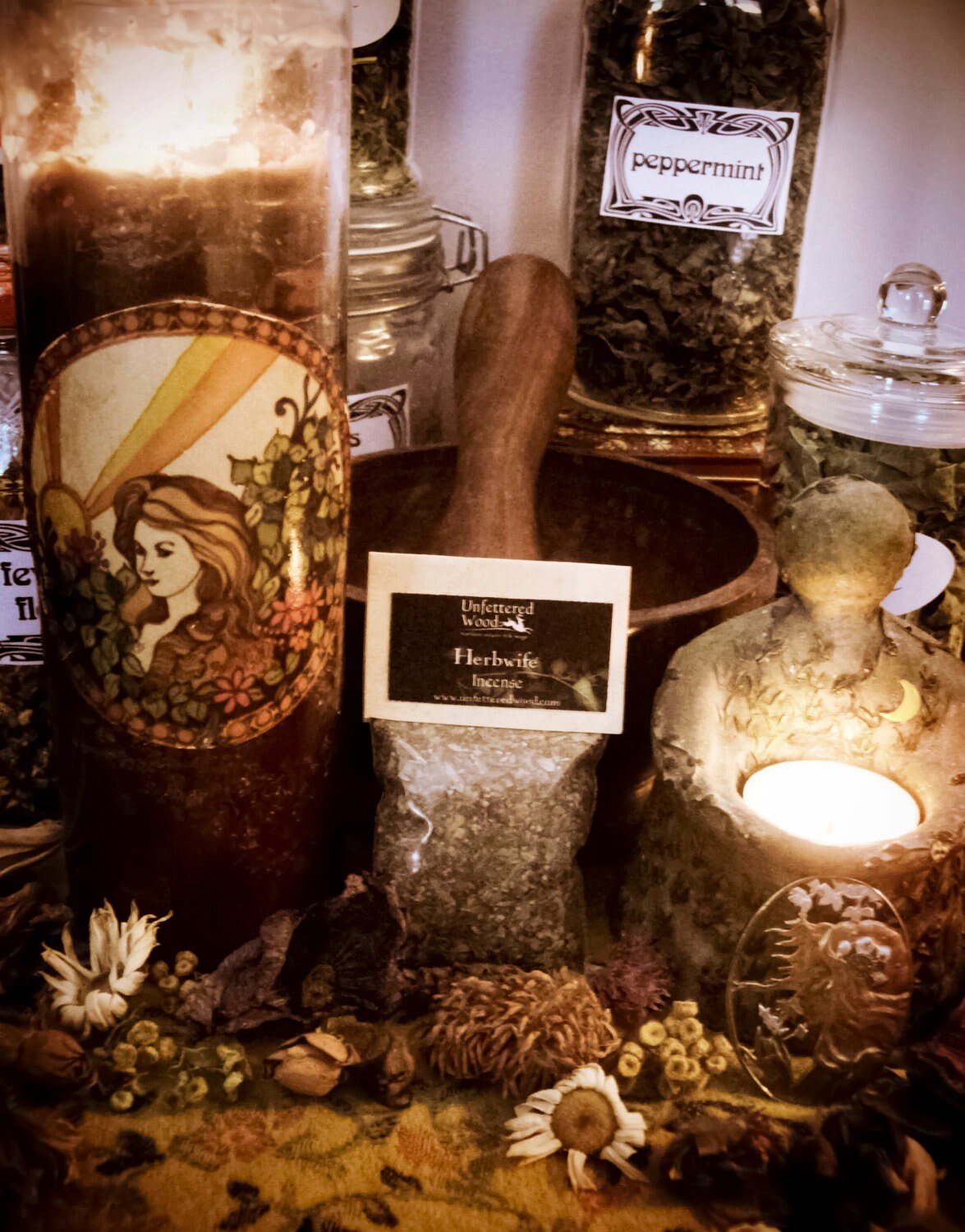
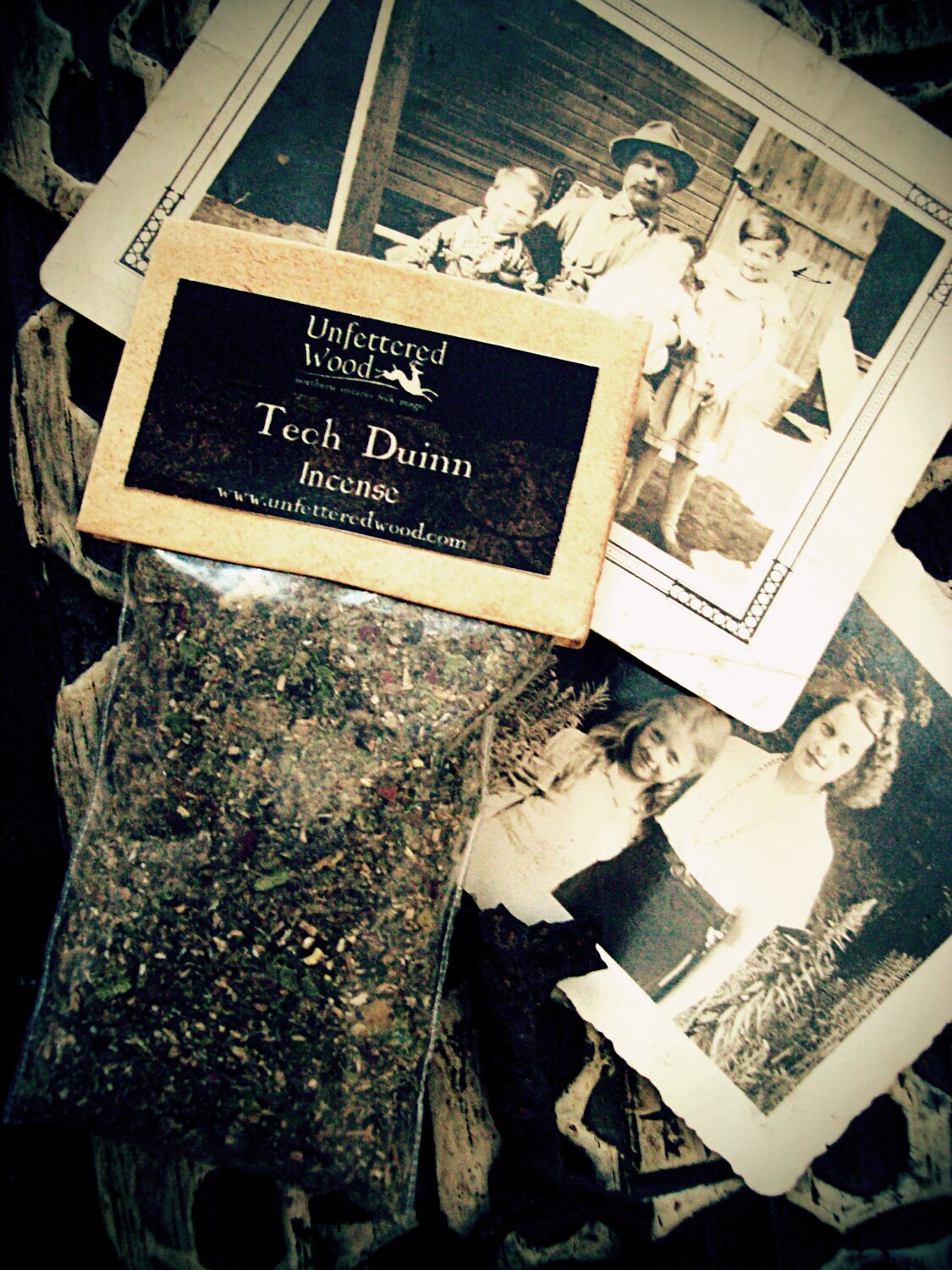
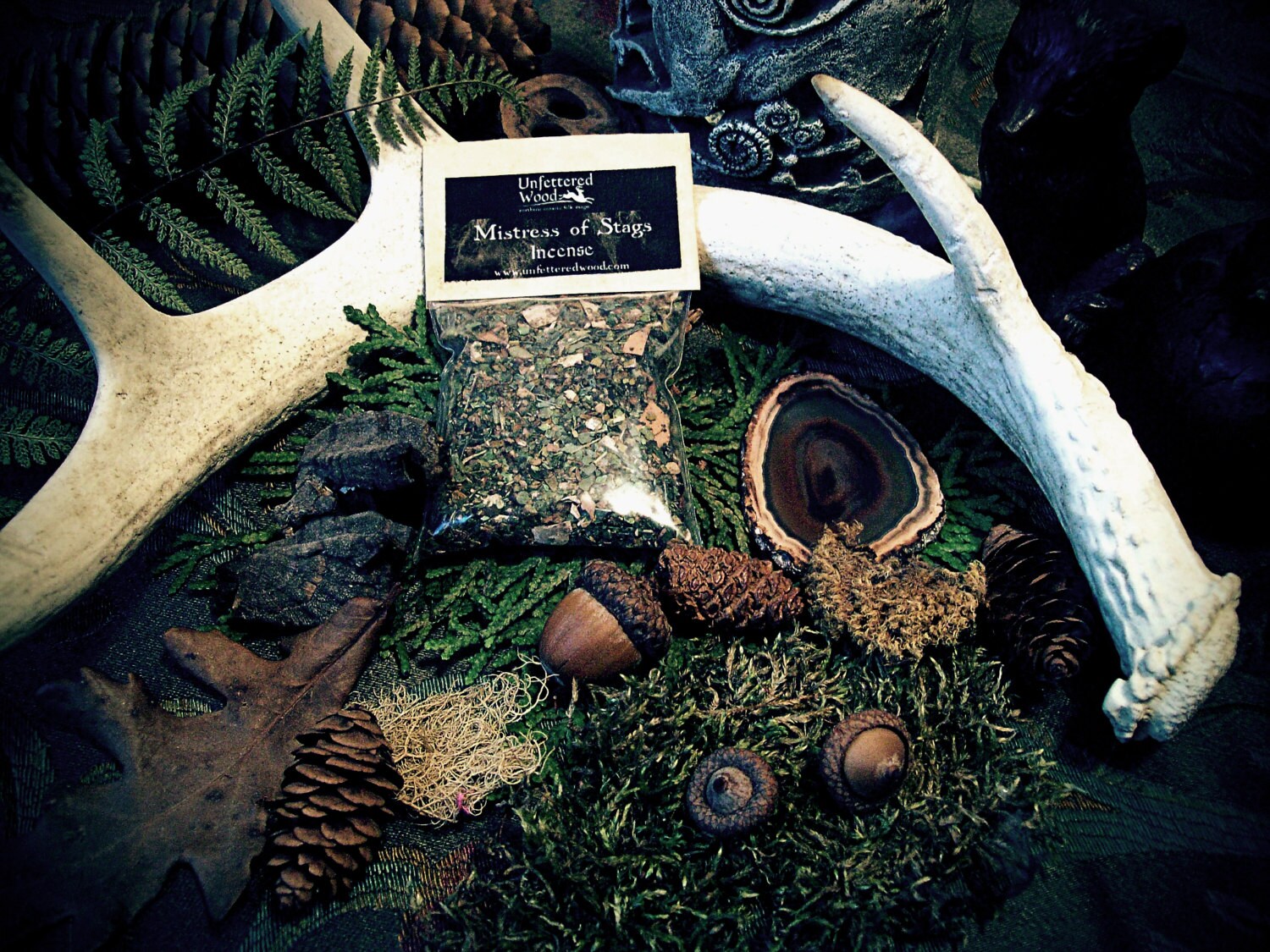
I have recently added three more incense to the Unfettered Wood Etsy shop. The newest additions are:


For herbcrafting and healing, and as an offering to Airmid.


For Samhain and necromancy rituals, and as an offering to Ancestors and Donn.


For workings involving woodlands, lust and sexuality, and wild animals, also for Bealtaine rituals and as an offering to Flidais and spirits of the forest.
 
*********
 
There are a few more blends that I use in my practice that I may make available for sale sometime in the near future.
 
Sláinte!
 
Laurel


Monday, November 26, 2012

Using Botanicals to Dye Magical Textiles

A few days ago I did some natural dyeing, so I thought that I would share a wee bit about that in case other folks would be inspired to give it a go. Please keep in mind that there are different ways that one can dye textiles with botanicals, this is just they way that I have been comfortable with.
 
There are a few things that all methods have in common:
  1. Extracting colour
  2. Fixing colour
  3. Transferring colour
I would highly recommend people going through the resources that I will put at the end of this post to get more ideas to see what works for them.

The whole purpose of me doing this was to infuse the magical properties of the plants into the textiles, as well as obviously leave some colour on them as well.

  
For this batch the actual magical properties of the plants were of more importance to me than the colour. I wanted something that could be a good general purpose textile and wasn't quite sure how the colours would turn out. In one of the extra resources at the bottom of this post, there is a list of different plants and the colours they give off.
 
 
For fresh ingredients this is not necessary, but berries apparently benefit having a soaking in vinegar before simmering. This is a good time to do a blessing over the plant materials should you wish to, or to "charge" them with intent.
 

Using cold water is best to add for the vinegar, and after simmering giving the fabric a good rinse in cold water {water it runs clear} is needed. Other methods call for the fabric to be wet before putting it in with the dye wash, so this takes care of both the fixative and that step. Other fixatives are sometimes added to the actual dye wash or used to treat the textile afterwards. Learn more about fixative in the resources below.
 
 
Other methods call for a lower simmering time, depending on the materials being used. Sometimes fixatives, such as salt are added at this stage.
 
 
This is probably not a must, but it will make stage six a whole lot easier. As you will see in the follow photos, I did not strain all of the plant material out; some of it stuck to the fabric, which I just shook off outdoors once I was finished drying them out. I put the strained off bits into the compost.
 
 
The textile I used was a natural coloured cotton linen and I left it in the dye wash for a couple of hours. I shifted it around every once and a while with a pair of tongs. If handling, it is best to used a pair of rubber gloves so you don't dye your hands!
 
 
Before removing from the dye bath, carefully squeeze out as much of the liquid as you can. To get the concentrated veins of colours, I left my fabric bunched in a pile on a dish drying rack {made black rubber, no risk of it staining!} over night. Then I dried out flat on our clothesline.

Extra resources:

Using Natural Plant Dyes by Kate Aimson {from White Dragon Magazine}
Natural Dyes: Their History and How to Make Them by Varenya
Making Natural Dyes from Plantsfrom Pioneer Thinking {has a great list of plants and the colours they give off}


*********
a comparison of my linen before dyeing {top} and after dyeing {bottom}
It was exciting to see what the finished product would be and I am quite fond of the yellows, rusts and browns that came out in the linen. I will be using some of it in an upcoming project that I will post about later, as well as using some for charm bags and pouches.
 
For those who don't want to make your own, but would like some magical textiles, I will be listing some of this batch in the Unfettered Wood shop and I am happy to take custom orders.
 
Sláinte!
 
Laurel