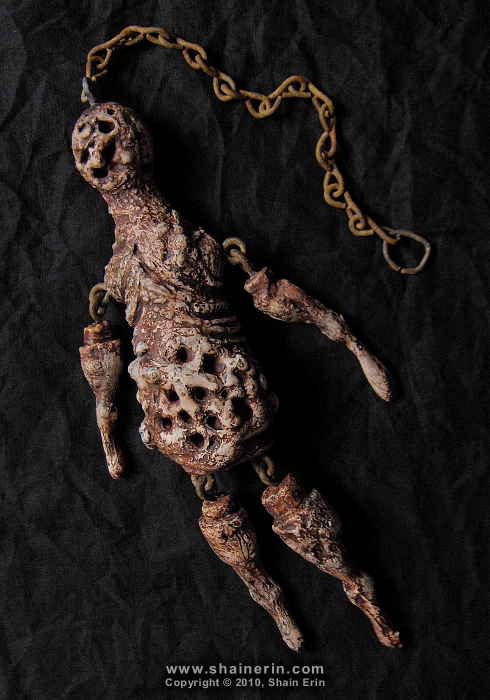
Cha dèan mi corp-criadhach dhut
cha nochd do chruth na mo dhàin
cha chuir meallachd mar a chuir
na seann bhàird air luchd an gràidh
Thogadh iad luidheag bhon ùir
an cumadh na dùilleag bochd
ga milleadh is boinnean bùirn
a’ sileadh ’s drùidhteadh tron chorp.
’S ann leatsa tha d’ àileachd fhèin
’s i gun fheum air m’ fhaclan fann
gus a toirt don aimsir chèin
ann an caint bhreugach gach rainn.
Chan fhalaich mi d’ ìomhaigh òr
cha mhair seo ach mairidh i
bheir mi air ais thugad beò
do dhealbh; cum, a stòr, do bhith.
*********
I will not make you a clay-corpse,
your shape will not find itself in my poems;
Bards of old praised the ones they loved;
I will not put such a cursed blessing upon you.
They hoisted a doll of rags from the ground,
a mirage of a wretched girl
being destroyed by drops of water,
washing through and penetrating the corpse.
Your beauty is yours to command;
my words of vanity, echoing
with the false language of each stanza,
cannot preserve it for posterity.
I will not hide your golden image –
this will not endure, but it will –
I will bring it back to you, your shape;
Beloved, keep your life.
Over the last little while I have been looking into the historical use and folk references to the use of a
corp criadhach in the hopes of finding out more for my own personal practice. Essentially, a
corp criadhach or clay corpse/clay body is a Scottish variant of a
poppet.
I have been working with poppets for a good while now for healing and other beneficial magic, but I have only come across one source that mentions them being used in love magic. For the most part in Scottish folk magic at least, they were used for more sinister purposes.
"Clay corpse. When a witch desired to destroy any one to whom she had an ill-will, she often made a corpse of clay resembling the unfortunate one and placed it in some out-of-the-way burn under a precipice, in such a way that the water trickled slowly on it. As the clay body wasted so the live body of the person it resembled was also supposed to waste away. Were the body found, it was carefully preserved and so the spell of the witch was broken. Sometimes pins were stuck in the clay body to make the death of the doomed one more painful. Several such bodies have been found, even of late years."
In Perthshire a piece of wood stuck with pins was used against a minister. The out come was, "burning pains all over his body, and was slowly wasting away by some malady of which the nature could not be understood." Eventually the piece of wood was dug up by a woman who snuck up on the culprit while she was burying it, and once the pins were removed from the wood, the minister is said to have recovered. {Witchcraft & Second Sight in the Highlands & Islands of Scotland}
Another case is of Lady Fowlis {Catherine Ross} was indicted of witchcraft after she was accused of seeking the services of witches to create likenesses of her victims, fashioned out of clay. According to Alexander MacGregor in
Highland Supersitions:
"The nature of these effigies can be explained. Such as were intended to be doomed, or destroyed, were formed out of clay into hideous figures, or rude statues larger than life-size. These were called cuirp-creadha or bodies of clay. Once formed, incantations and spells were uttered over them. Pins, nails, and feathers were pierced into them, and fairy arrows darted against them, with fearful oaths and imprecations. Such things Lady Fowlis resorted to for destroying her relatives..."
"They devoted the male children of this gentleman (of the well-known family of Gordon of Park, I presume) to wasting illness, by the following lines, placing at the same time in the fire figures composed of clay mixed with paste, to represent the object: --
We put this water amongst this meal,
For long dwining and ill heal;
We put it in into the fire,
To burn them up stook and stour.
That they be burned with our will,
Like any stikkle in a kiln."
Sláinte!
Laurel